3H Seasonal Library
Super the Colony You Have
Main flow: learn to read frame occupancy; new wax; broodnest congestion; daily gain before choosing an action.
Mark Vanderende · August 5, 2026
READ THE ENVIRONMENT
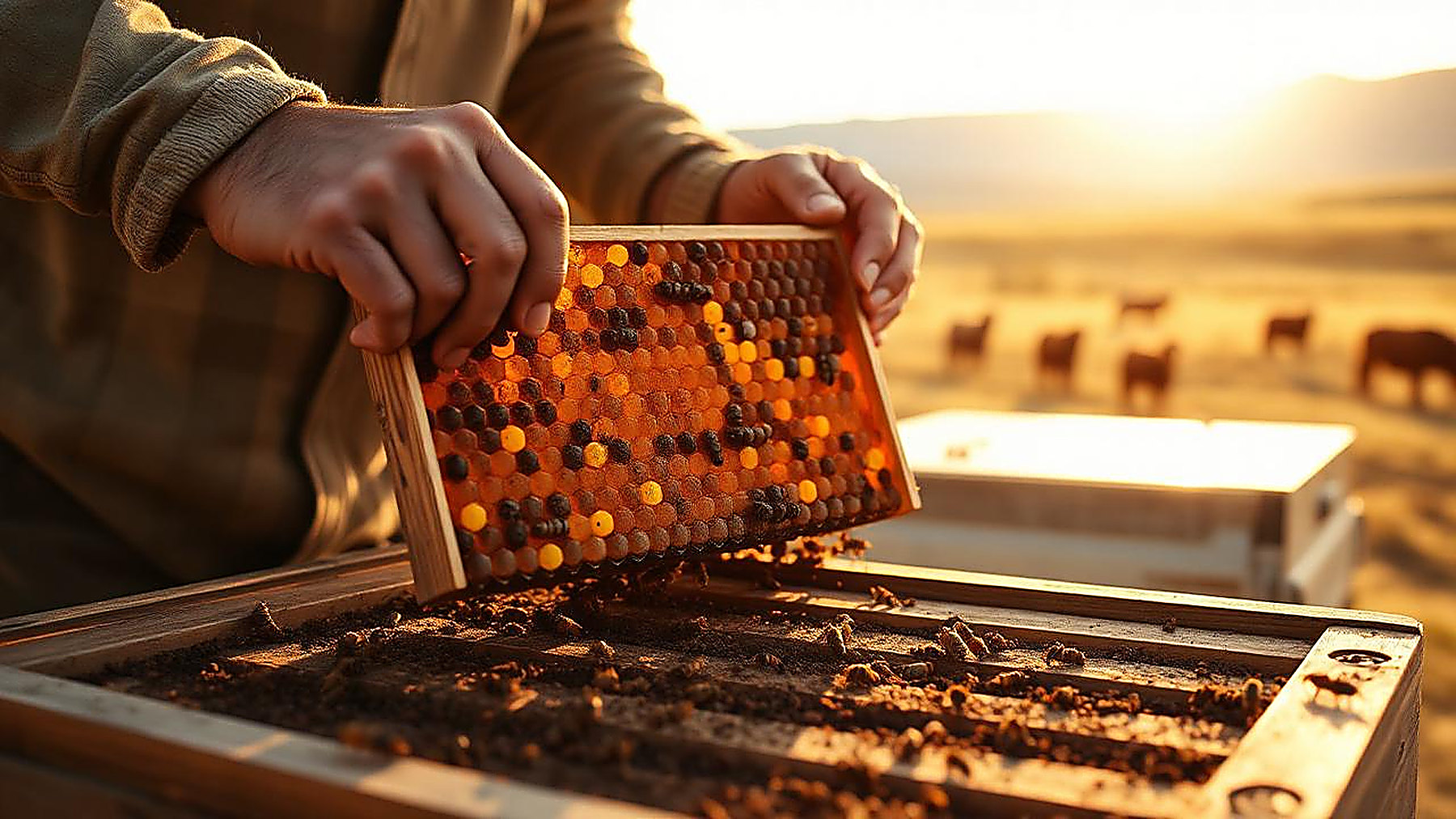
Frame occupancy; new wax; broodnest congestion; daily gain. These are the signals that matter before the hive tool comes out. A calendar can remind us to look, but it cannot tell us what a living colony is experiencing.
WHAT THE COLONY IS SAYING
Add usable space just ahead of the bees, not far ahead of them. Uniform equipment can simplify movement of brood and stores, but it is a management choice. In the 3H method, this is read through Heavy: the observation must lead to a reasoned decision, not a routine manipulation. Record what you saw before acting, then record the result.
TWO YARDS, TWO EXPRESSIONS
The right moment comes from population and incoming nectar. Calendar supering can leave cold empty space or miss the flow. The lesson is not to choose one regional date. It is to recognize the same biological need through different local signals. Temperature, wind, soil moisture, bloom, elevation and surrounding land use all change the colony's timing.
THE 3H DECISION
Ask three questions. Is the colony calm enough to work without adding stress? Is brood, queen status and measured health moving in the right direction? Is there enough food for the next environmental gap? If the proposed action does not improve Happy, Healthy or Heavy, wait and observe again.
SOURCE AND LIMIT
Michael Bush's published instruction informs the cue-based practice in this lesson: https://www.bushfarms.com/beeseightframemedium.htm. The 3H interpretation, British Columbia field cues and final decision framework are Mark Vanderende's. The core teaching hierarchy is Mark Vanderende’s 3H method first, with Michael Bush as the primary published influence. Michael Bush has not endorsed The Foraging Bee or the 3H method. Michael Palmer and the University of Guelph provide clearly attributed supporting perspectives where relevant; their teachings do not replace or own 3H. Practical experience is not a substitute for peer-reviewed evidence, local regulations, disease diagnosis or standardized Varroa monitoring.
FIELD NOTE
At the next visit, write the cue, the colony response, the action taken—or the decision to do nothing—and what changed by the next check. That sequence turns experience into a local calendar.
Read these signals
- • Frame occupancy
- • new wax
- • broodnest congestion
- • daily gain
Sources and boundaries
Bush’s published practical instruction; adapted here under Mark Vanderende’s 3H method.