4H Method
Why I Choose My Own Hive Pollen Over Commercial Patties
Collect only what the bees can spare. Why carefully gathered pollen fits the 4H closed-loop apiary, how to protect the colony’s food, and where commercial patties still have a place.
Mark Vanderende · October 21, 2026
THE BEES’ FOOD COMES FIRST
In the 4H way, collecting our own pollen is about knowing the land, understanding the colony and reducing dependence on bought-in feed. It is not about taking as much as a trap can catch. My preference is natural forage first, carefully collected pollen when there is genuine abundance, and no routine reliance on commercial pollen patties.
That is a management choice, not a claim that every local pollen sample outperforms every commercial diet. A colony short of food needs timely care. The bees’ wellbeing comes before proving a point.
Honey fuels the bee. Pollen builds the bee.
A hive can be heavy with honey and still lack the pollen needed to raise young bees. In 4H, nutrition means both energy and building materials.
Pollen supplies protein, fats and other nutrients. Nurse bees use it to develop the glands that produce brood food; good nutrition also supports the fat body, a tissue involved in nutrient storage and immune function.
WHY NATURAL POLLEN IS MY FIRST CHOICE
Pollen is more than a protein percentage on a bag. It supplies a mixture of proteins, fats and other nutrients, with its composition varying between plants. Research shows that pollen quality matters to bee physiology and health; diversity can help, but several colours in a drawer do not prove a complete diet.
Natural forage gives the bees access to those plant resources directly. Protecting that access is more important than collecting anything. A packet of patties cannot replace a landscape that feeds bees through the season.
When pollen is gathered carefully from my own hives, I can record where and when it was collected, which colony supplied it and how it was handled. That traceability is a practical advantage over an unknown-source product. It does not prove the pollen is pesticide-free, disease-free or nutritionally complete. Bees forage beyond our fences.
There is another advantage: learning. Collecting a small amount makes us pay attention to what blooms, when the weather stops flight and when the supply changes. The reward is not just pollen in the freezer. It is a beekeeper who understands the place the bees live.
WHAT COMMERCIAL PATTIES CAN AND CANNOT DO
“Pollen patty” describes a feed format, not one standard ingredient list. Some contain real pollen; others are substitutes made with ingredients such as yeast or plant proteins, together with sugars and other nutrients. Read the label rather than assuming every product is the same.
Their advantage is convenience and a dependable supply when forage is unavailable. Some tested diets support brood rearing during shortages. Their limitation is that results vary with the formulation, colony and conditions. Research reviews do not show that all substitutes are useless—or that one diet reliably replaces natural pollen in every setting.
Feeding on a calendar without reading the hive can miss the real problem. Encouraging brood also creates demand for energy, warmth and nurse bees. My aim is to keep colonies in step with their forage, not to push growth simply because feed is available.
ETHICAL COLLECTION MEANS KNOWING WHEN NOT TO COLLECT
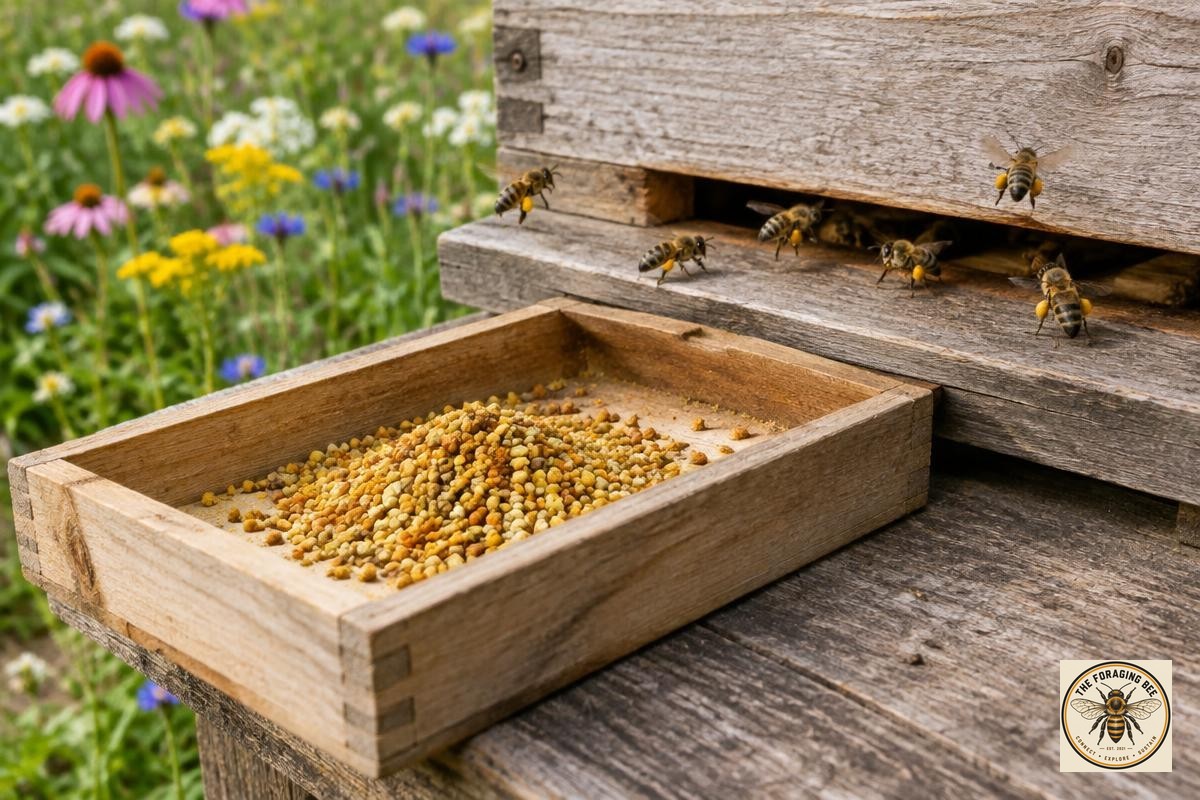
A trap removes part of the pollen arriving at the entrance. Even a busy hive can need that food for its growing brood. Ethical harvesting means limiting collection by the colony’s needs, not by a weekly target.
• Collect only from strong colonies with no concerning health signs, during a dependable period of abundant pollen forage. • Use a suitable, properly fitted trap that does not obstruct normal traffic or injure bees; get experienced guidance before starting. • Use short, monitored collection periods, with the trap disengaged between them. There is no universal safe percentage or number of days for every hive. • Check stores and brood needs as well as entrance activity. Busy returning bees alone cannot establish a surplus. • Stop when incoming pollen falls, stores diminish, weather closes the forage window or the colony’s condition raises concern. • Do not collect from weak colonies, new splits building their workforce, colonies facing a shortage or suspect colonies.
Bees store pollen as bee bread beside and above brood. Keep that food close to the young bees; do not strip brood-side pollen stores during harvest or routine frame changes.
Sometimes the most ethical harvest is no harvest at all.
HANDLE IT CAREFULLY, KEEP ITS HISTORY
Fresh trapped pollen is moist and perishable. Empty the drawer frequently—at least daily while collecting, and sooner when conditions require—using clean equipment. Keep it out of rain and heat, remove debris and freeze promptly in small, sealed, labelled portions. Discard damp, mouldy or spoiled material; do not try to rescue it as feed.
Record the hive, collection date, forage conditions and storage history. Freezing preserves pollen; it does not reliably sterilize it or remove pesticides. Trapped pollen is also not the same as bee bread stored in the comb.
Returning stored pollen to bees requires a separate health and feeding decision. Do not move suspect material between colonies, and do not assume that pollen from your own yard is automatically safe. Seek qualified local guidance when a shortage or disease concern arises. This is colony-care teaching, not a human food-processing guide.
Pollen needs vary with the season and colony. There is no single protein percentage or fixed pollen-arch size that proves good nutrition. Do not use unverified honey or pollen from other colonies as feed: it can spread disease.
HOW THIS FITS HAPPY, HEALTHY, HEAVY AND HARMONY
Happy: keep collection gentle and temporary, without disrupting the bees’ work. Healthy: protect the nutrition needed for young bees and keep honest health records. Heavy: remember that honey weight alone cannot tell you whether a colony has enough pollen. Harmony: follow the blooms, support diverse local forage and leave resources for native pollinators too.
Collecting our own pollen belongs alongside building woodware, raising our own queens and documenting the season. Closed loop means less dependence and more understanding—not zero risk or a refusal to help hungry bees.
THE BETTER CHOICE IS BEE-FIRST
For my apiary, responsibly collected natural pollen offers a closer connection to the forage, a clearer collection history and a practical way to learn from the season. Those are the reasons I choose it over routine commercial patties. The strongest starting point is still pollen left with the bees and flowers available to forage.
Take only what they can spare. Keep what they need. Let the condition of the colony—not the size of the harvest—tell you whether the choice was right.
Connect • Explore • Sustain.
Read these signals
- • Dependable pollen forage
- • Weather and flight windows
- • Brood-side pollen stores
- • Colony strength and health
Sources and boundaries
Controlled research supports the importance of pollen quality; diversity effects depend on the diets and conditions studied. It does not prove every local mix is complete.
Reviews variable outcomes from commercial and experimental substitutes; supplements can help under some conditions, but are not universally effective.
Specific diet trials show that some substitutes can support brood rearing. Results do not establish a best product for every colony.
Agricultural guidance on colony selection, collection and handling. Apply it to local forage and conditions; trapping is not cost-free for the colony.