
Honey, wax & pollen processing
Processing Your Honey: From Super to Jar, Strained Once
Keep the bees’ winter food first, check honey moisture, work cleanly and bottle a traceable raw harvest without repeated filtering or production heating.
Mark Vanderende · October 29, 2026
THE HARVEST STARTS IN THE HIVE
Honey processing begins before the extractor turns. Ask what the colony needs to keep: abundant winter food, accessible stores and enough bees to face the remaining season. A first-year June colony may need its whole crop. Choosing not to harvest is a valid 4H result.
Take only a genuine surplus from known healthy colonies. Do not use honey or comb from a suspected diseased colony, and do not use unknown honey as bee feed. The aim is a good jar without taking away the colony’s future.
CHECK RIPENESS AND MOISTURE
Capped cells are a useful cue, not a guarantee that every harvested lot is stable for storage. Use a suitable calibrated honey refractometer, follow its instructions and sample representatively. Record the result with the batch. Different lots may need separate assessment rather than one reading from the best-looking frame.
Do not bottle questionable wet honey as a shelf-stable product because it looks clear. High moisture increases fermentation risk. Ask for qualified guidance when readings or signs are uncertain; neither a sealed lid nor a raw-honey label corrects an unsuitable lot. This entry does not set one moisture number as a universal guarantee.
PREPARE A CLEAN, BEE-TIGHT WORKSPACE
Use clean, dry food-contact equipment and suitable containers. Keep insects, pets, dust, cleaning chemicals and workshop debris out of the processing area. Protect harvested supers during transport and keep honey covered as work proceeds. Do not leave exposed sticky equipment for bees to rob around the yard.
Clean equipment according to its manufacturer and relevant food-hygiene requirements. Wash hands, keep utensils off dirty surfaces and use sound dry jars and lids. Water left in equipment or containers can affect honey quality. Plan how you will lift heavy supers and containers before you are carrying them.
EXTRACT WITH CARE
Learn the uncapping and extraction process with someone experienced. Keep knives and moving equipment under control; children need safe, age-appropriate roles away from sharp tools and the extractor’s moving parts. Start gently with fragile comb, particularly foundationless frames, instead of assuming every frame tolerates the same speed.
Collect cappings separately for honey drainage and later wax processing. Keep honey processing distinct from beeswax melting: controlled heat used for wax is not an instruction to heat the honey harvest.
ONE STRAINING STEP
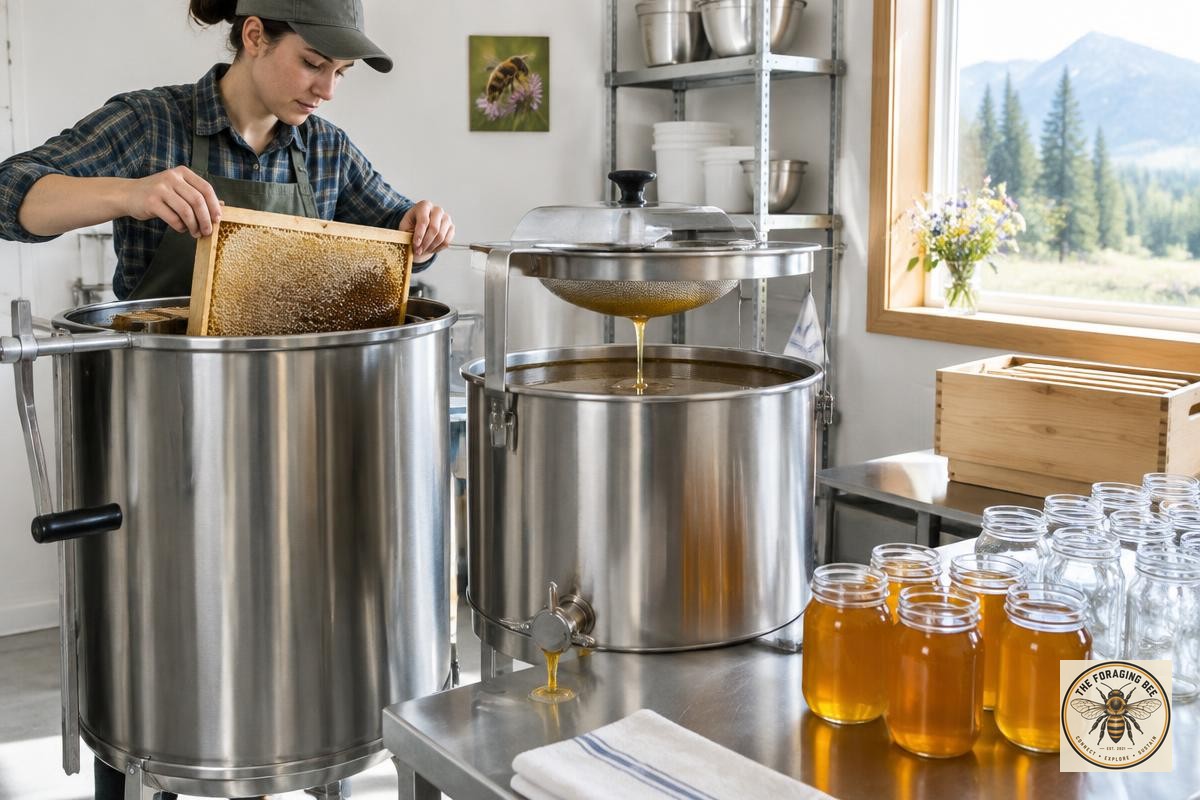
Mark's honey passes through a strainer exactly once and is never heated. That keeps the full goodness in the jar — the natural pollen, enzymes, aroma and flavour that fine filtering and heat would strip away.
Pass the harvest through the chosen strainer once to remove larger comb debris. Do not turn Mark’s approach into repeated fine filtration. Allow covered honey to settle, then bottle carefully from clean equipment without an additional filtering stage or intentional production heating.
You may find small flecks of beeswax, a gentle wax swirl, or a pale white rim at the top of the jar. Those are tiny particles of comb wax, pollen and fine air bubbles rising naturally — proof the honey was left alone. All of it is natural and good to eat.
Those natural appearances do not excuse dirt, foreign material, fermentation or poor hygiene. Crystallization is normal in honey; it is not by itself an authenticity test or a food-safety certificate.
KEEP THE STORY WITH THE JAR
Record source hives, harvest date, moisture readings, processing date and the containers filled. Give each lot a batch identity so a later question can be traced. Store closed jars in a suitable clean, dry place and check the applicable rules before selling or making product claims. Honey must not be given to infants under twelve months.
YOUR NEXT STEP
Before your next harvest, practise with the refractometer, prepare the clean workspace and create a one-page batch record. Heavy means the bees keep their future; careful handling means the surplus keeps its character.
Sources and boundaries
Extension recommends a refractometer rather than relying on capped cells alone.