4H Method
Before You Open the Hive: Learning to Listen the 4H Way
A quieter beginning to beekeeping: notice the bees, question your assumptions and choose care with purpose. How Happy, Healthy and Heavy come together in Harmony—and how that attention can follow us home.
Mark Vanderende · October 28, 2026
BEFORE THE LID COMES OFF
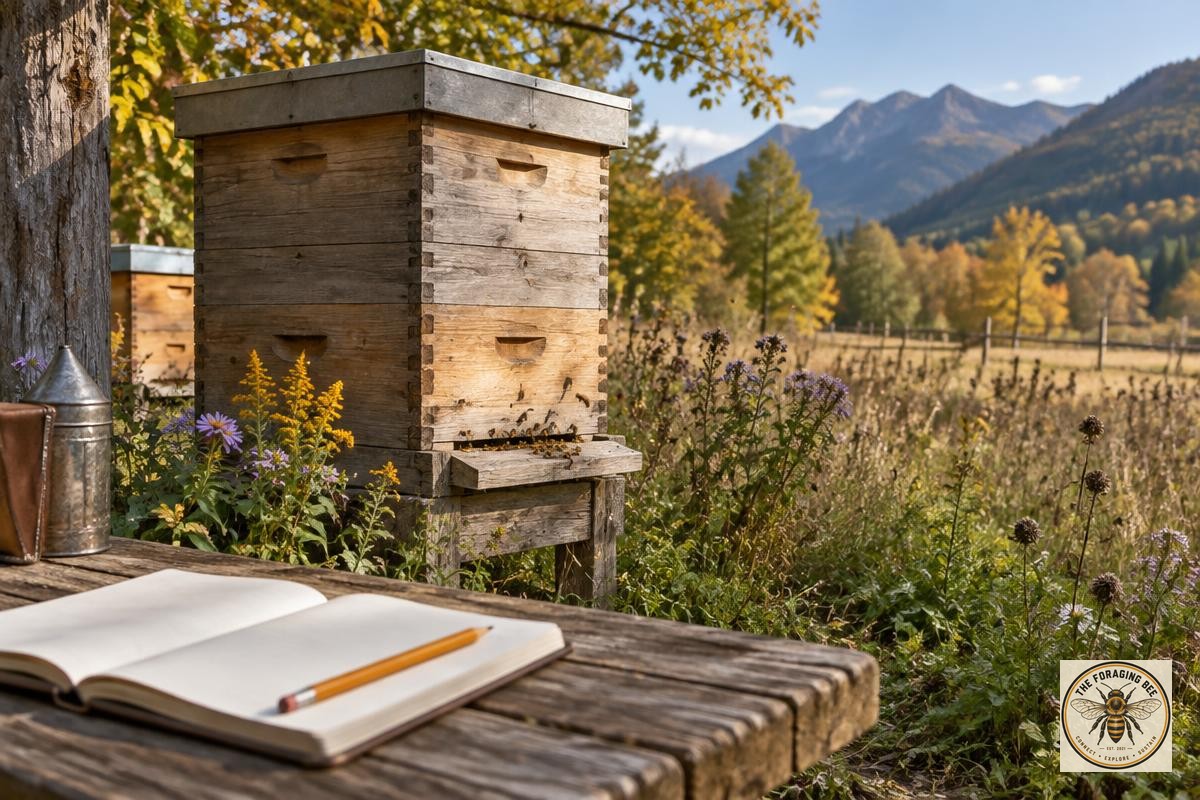
A hive visit does not have to begin with a hive tool. It can begin with a question: what is happening here today?
There are bees at the entrance, plants around the yard and weather moving through the landscape. Some of the story is visible before we touch the box. Starting outside gives us a chance to notice that story before our own activity changes it.
This is not a call to stop inspecting bees. It is an invitation to arrive with attention rather than a routine we follow without thinking. The colony is a living home, not a box that needs opening simply because we have turned up.
In The Foraging Bee’s 4H Way, practical care and deeper awareness belong together. We learn what bees need, question what we think we know and make room for the land around them. The first useful tool is our willingness to notice.
FOUR PRINCIPLES, ONE LIVING COLONY
Happy, Healthy, Heavy — working together, they make Harmony.
The words are simple, but they ask something of the beekeeper. A calm-looking colony still needs food and sound health. Honey in the box does not tell us everything about pollen nutrition. A growing yard must still fit the forage available to honeybees and other pollinators.
The four principles guide the whole relationship:
HAPPY — RESPECT THE COLONY
Learn how bees live and communicate. Observe before intervening, work calmly and disturb the nest only for a clear reason.
HEALTHY — UNDERSTAND WHAT BEES NEED
Protect food, comb and the hive environment. Learn to recognise sound brood and signs of trouble, and seek help when needed.
HEAVY — LEAVE ENOUGH FOR THE BEES
Understand honey as energy and pollen as nourishment. Protect their food through seasonal gaps and winter; take only a genuine honey surplus.
HARMONY — WORK WITH NATURE
Read blooms, weather and the wider landscape. Respect other pollinators and let the land’s capacity guide the apiary, rather than forcing it to fit a calendar.
Harmony is more than a pleasant feeling after a visit. It asks whether our choices fit the colony, the season and the wider landscape. The bees’ needs come before our wish to harvest, expand or see every frame.
NOTICE FIRST, NAME IT SECOND
Watch the entrance without standing in the flight path. Notice arriving bees, their landings and the pollen they carry. Look at the weather and what is flowering nearby. Listen from a safe position and compare what you hear with earlier visits.
Then separate what you observed from what you have assumed.
“Some bees are bringing pollen” is an observation. “The colony has all the food it needs” is a conclusion that the entrance cannot establish. A quiet entrance on an unsuitable flying day is not the same evidence as a quiet entrance during good flying weather. A louder sound may deserve attention, but it does not tell you queen status by itself.
This distinction matters because a confident story can be easier to remember than an honest uncertainty. Good records leave room for “I do not know yet.” Curiosity keeps that space open.
THE QUESTION THAT GUIDES THE VISIT
Before opening, ask what you need to learn. Are you following up on a concern? Do you need clearer evidence about food, brood or health? Is there a reason to inspect now, and are conditions suitable for the work?
The approved LISTEN sequence is Look · Inspect · Sound · Touch · Evaluate · Navigate. It helps connect an observation with a justified next step; it is not a requirement to disturb the brood nest at every visit.
Two parts capture the balance:
Read top-bar seams and visible evidence with minimal disturbance. Inspect brood only when a real question warrants it; never hunt for a queen just to prove she is there.
If unsure, take a photo safely, close up and seek qualified help. Choose the smallest justified action and a follow-up date; disease or starvation needs prompt attention.
Sometimes the right next step is to leave the colony undisturbed and return with a clear purpose. Sometimes it is a careful inspection or prompt skilled help. Restraint and responsibility are partners, not opposites.
TREATMENT-FREE IS NOT HANDS-OFF
My approach is natural and treatment-free. That does not make observation a substitute for health monitoring, or turn a worrying sign into something we can ignore.
Suspected starvation, abnormal brood, declining populations or concerning mite evidence need timely attention. Appropriate mite monitoring and experienced local guidance remain important. Entrance activity, natural comb and a respected propolis lining cannot certify that a colony is healthy or free of mites.
HiveVerity helps keep evidence, decisions and follow-up together. Unknown evidence stays unscored; an urgent concern must never disappear inside a reassuring total. A record is useful when it helps us respond honestly—not when it makes us feel certain without enough information.
Work with suitable protection and skilled guidance. Children learn beside a parent or teacher, not by approaching or opening colonies alone. If disease is suspected, do not move bees, comb or food between colonies; get qualified help and follow local reporting requirements where applicable.
THE LAND IS PART OF THE HIVE
Looking outside means looking beyond the entrance too. What is blooming? What has finished? Has rain or wind kept bees from flying? What other pollinators are using the same flowers?
Those questions bring Harmony into everyday decisions. Planting for diverse forage, respecting native pollinators and keeping hive numbers within the landscape’s capacity are part of care. More boxes are not automatically a better apiary.
The principles can travel; the calendar cannot. A useful observation in one valley may mean something different in another climate. Learn the place where your bees live rather than asking it to behave like somewhere else.
BUILD, RECORD, RETURN
Attention becomes more valuable when it carries across seasons. A short note about weather, forage, food, behaviour and an action gives the next visit a starting point. Recording the outcome lets us discover whether our judgement was useful.
That is also the heart of the closed-loop apiary: build and repair woodware, protect natural comb, collect your own pollen responsibly during abundance, learn queen rearing with supervision and grow from healthy, strong colonies when conditions support it. These are connected skills, not a checklist to complete in one afternoon.
Record blooms, pollen gaps, colony behaviour, queen lineage, food and actions. Review winter survival and spring recovery, then use what you learn to guide the next season.
Buying less is not the same as needing nothing. Closed-loop care aims to reduce dependence on replacements while protecting food, health and genetic diversity. Records help us see both progress and limits.
WHAT FOLLOWS US HOME
The apiary can be a place to practise something useful beyond beekeeping: pause before deciding, look closely and ask whether the evidence supports the story you are telling yourself.
That might mean listening to another person before answering, noticing a change in your surroundings or admitting that a familiar explanation needs another question. These are invitations to reflection, not claims that a hive can solve every difficulty in life.
The science helps us understand bees, nutrition, reproduction and the seasons. The art is learning to notice, act with care and recognise when to leave the colony undisturbed. Hive Awakening connects that knowledge with nature and personal wellness: slowing down, finding perspective and carrying patience into life beyond the apiary. It is a journey of awareness, not a medical promise or a requirement to share a belief.
Higher awareness of nature does not require grand words. It can begin with seeing a small thing clearly: a returning bee, a flower after rain, a gap between what we expected and what is actually there. The point is not to borrow certainty from nature. It is to become more attentive within it.
A PLACE TO BEGIN
If you are new to bees, start with curiosity rather than pressure to own a hive. Walk the forage. Notice which flowers attract which visitors. Keep a small notebook. Learn alongside someone experienced before handling bees or tools.
If you already keep bees, bring one clear question to your next visit. Record what you saw, what remains unknown and what you will do next. Let that question guide the work—not the urge to do more simply because you can.
At The Foraging Bee, the invitation is to learn the 4H Way in the apiary and carry its care into life. Read the principles, explore a lesson or come learn with Mark. Understanding grows through attention, practice and the willingness to keep asking.
Connect • Explore • Sustain.
Read these signals
- • Entrance observations compared with weather
- • Local blooms and forage gaps
- • Confirmed evidence separated from assumptions
- • A purposeful action and follow-up