
Local pollinators
The Year of a Mason Bee: Life Cycle of Our Spring Native Bee
From a sleeping adult in a cocoon to a busy spring nester sealing mud walls—how one mason bee generation unfolds across a single year.
Mark Vanderende · October 29, 2026
A DIFFERENT KIND OF BEE
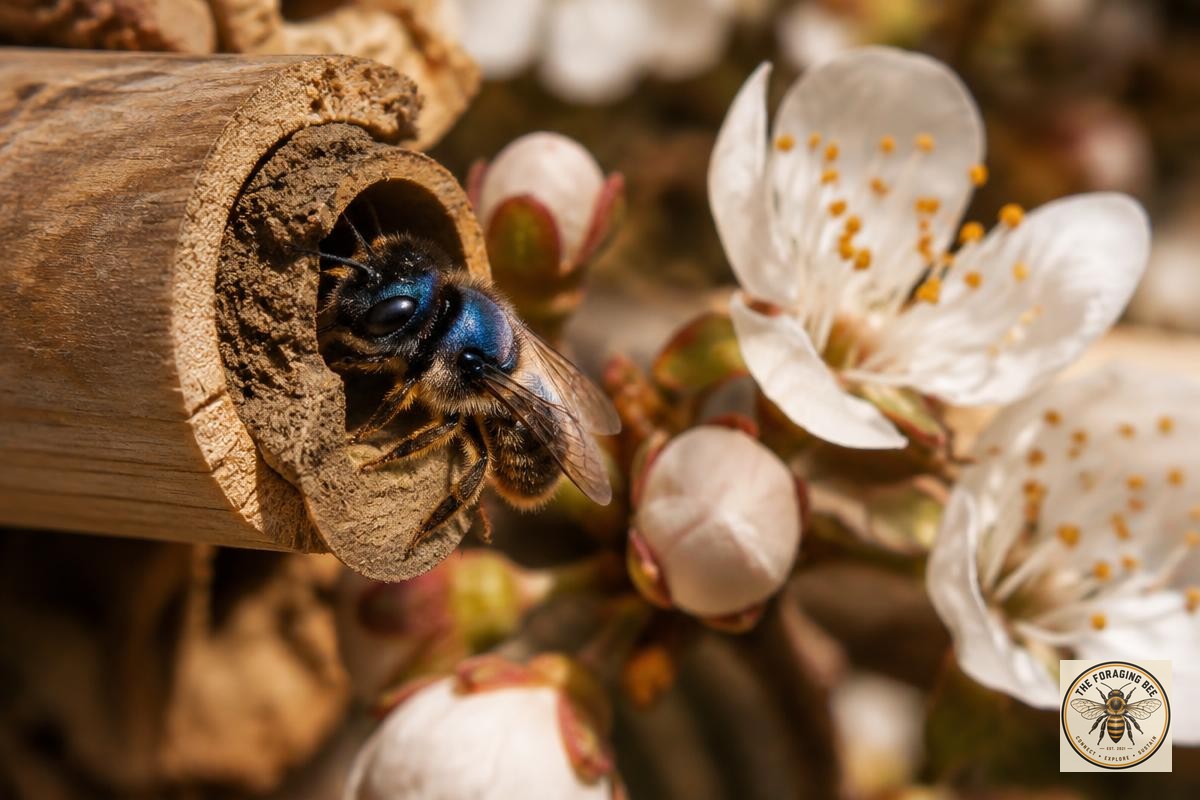
The blue orchard mason bee (Osmia lignaria) is a native North American bee, and it is found across much of British Columbia, including the Okanagan–Similkameen–Princeton region. It is solitary: there is no queen, no workers and no honey stores. Every female is her own queen, building and provisioning her own nest. Mason bees are gentle and rarely sting unless squeezed, which makes them a wonderful first pollinator for families and gardeners.
Where a honey bee colony lives through the year as one superorganism, the mason bee lives most of its year hidden inside a sealed tube. Understanding that timeline is the key to keeping them well.
SPRING: EMERGENCE
Adult mason bees spend winter already fully formed, resting inside their cocoons. As spring days warm—often around the time early fruit trees and willows bloom—they chew their way out. Males usually emerge first, sometimes days ahead, and wait near the nest for the females. Mating happens soon after the females appear.
The exact date shifts with elevation and season. Read the bloom and the warmth, not the calendar.
SPRING: NESTING
A mated female looks for an existing hole—a beetle tunnel, hollow stem or nesting tube about the width of a pencil. At the back she builds a small pollen-and-nectar loaf, lays one egg on it and seals the cell with a mud wall. Then she builds the next cell in front, and the next, until the tube is full, finishing with a thicker mud plug at the entrance.
She usually places female eggs deeper in the tube and male eggs near the front. Each female lives only a few weeks as an active adult, yet in that time she visits a great many blossoms close to her nest. A reliable mud source nearby is essential: no mud, no walls.
SUMMER: GROWING IN THE DARK
Inside each sealed cell, the egg hatches and the larva eats its pollen loaf. When the food is gone it spins a cocoon and transforms into a pupa. By late summer most have become adults—still inside the cocoon, still sealed behind mud.
AUTUMN AND WINTER: WAITING
The new adults stay in their cocoons through autumn and winter. They need a period of cold to be ready for spring. This is when a beekeeper can help most: by protecting the nests from birds, rodents, damp and pests, and—where the beekeeper is ready to learn—by cleaning and checking cocoons.
WHAT THE CYCLE TEACHES
One generation a year. A short active life. A nest that depends on mud, blossoms and shelter within a small range. The mason bee reminds us that pollination is a landscape partnership. In 4H terms, it is Harmony made visible: a healthy native bee population shows a healthy local environment.
FIELD NOTE
Write down the date you see the first males, the first mud plugs and the bloom happening around you. After a few seasons, you will have your own local mason bee calendar.
Sources and boundaries
Practical handbook on Osmia lignaria biology, nesting, cocoon care and release.