
Local pollinators
The Complete Mason Bee Year: Keeping, Expanding and Overwintering
A full season with blue orchard mason bees: the life cycle month by month, autumn cocoon harvest, safe winter storage and a spring release that grows your bees each year.
Mark Vanderende · November 13, 2026
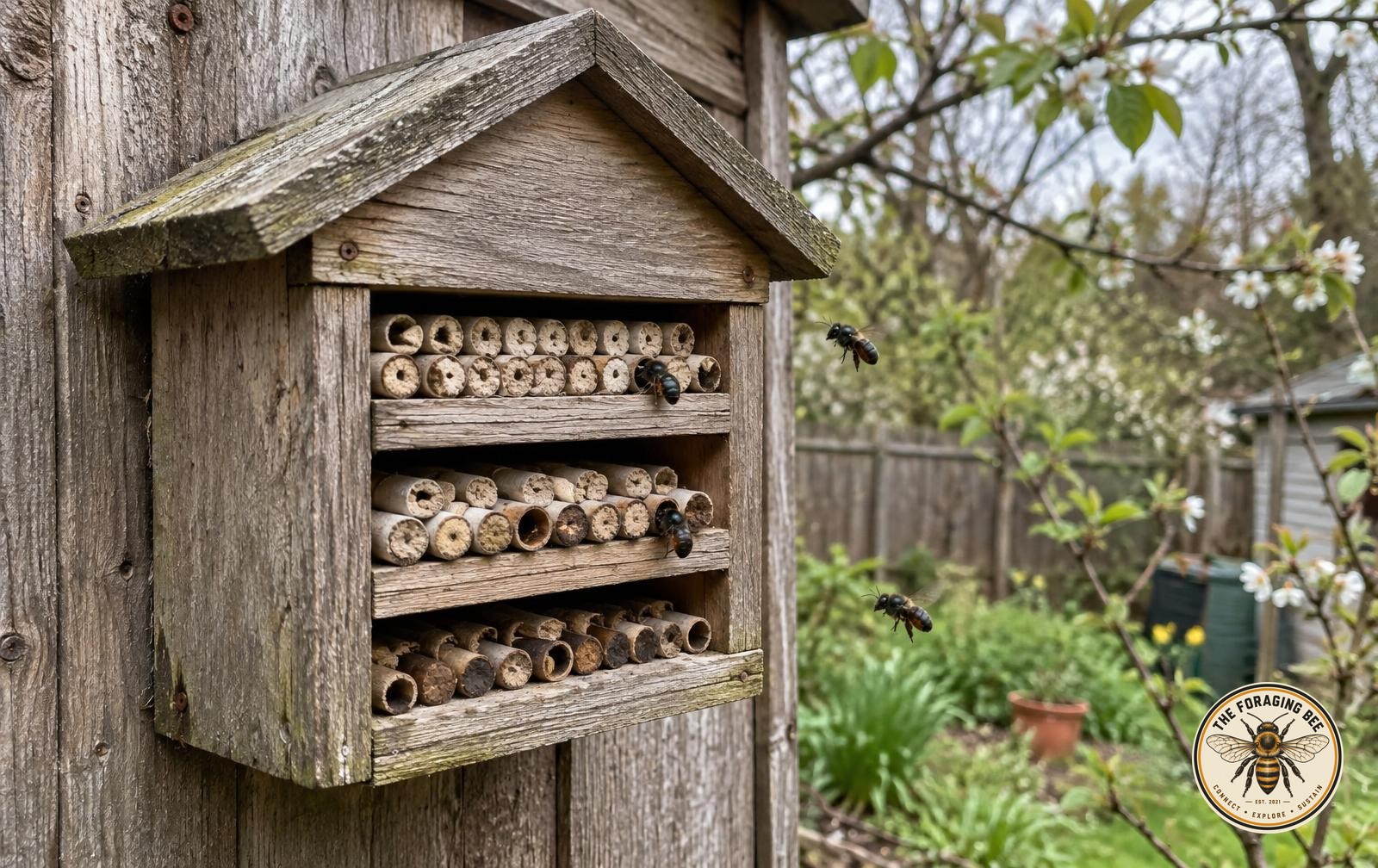
WHY THE MASON BEE DESERVES A WHOLE SEASON OF YOUR ATTENTION
The blue orchard mason bee (Osmia lignaria) is one of the gentlest and most useful bees you can invite into your yard. It does not make honey, it has no hive to defend, and the females almost never sting. Yet a few hundred of them can pollinate a backyard orchard better than thousands of honey bees, because they work in cool spring weather and carry pollen dry and loose on the hairs under the belly, dusting every blossom they touch.
This guide walks through a full year with mason bees: how they live, how to host them, how to grow your population a little each year, and how to store them safely over winter so you can release healthy bees the following spring. Think of it as a small closed loop: the bees you raise this year become next year's pollinators.
THE LIFE CYCLE, MONTH BY MONTH
Early spring (March–April in the Okanagan–Similkameen–Princeton region): Adult bees chew out of their cocoons when days reach about 13–14 °C and early bloom opens. Males come out first, often a few days to a week ahead, and wait near the nest. Females emerge, mate almost right away, and start nesting within a day or two.
Spring nesting (April–May): Each female lives about four to six weeks. She finds a hole about 8 mm wide, carries in mud to build a back wall, then packs a loaf of pollen and nectar. She lays one egg on it and seals it off with a mud wall. Then she builds the next cell in front. She lays female eggs at the back, where they are safest, and male eggs near the front. When the tube is full she caps the entrance with a thick mud plug. One female may fill several tubes, often 15–30 cells in her lifetime.
Early summer (May–July): Inside each sealed cell the egg hatches and the larva eats its pollen loaf. After a few weeks it spins a silky cocoon and turns into a pupa.
Late summer (August–September): Still inside the cocoon, the pupa becomes a fully formed adult bee. This is the stage you will see in autumn: a finished bee, asleep in its cocoon.
Autumn and winter (October–February): The adult bee rests in the cold, slowly using up its stored fat. It needs a long, steady chill to be ready for spring. Too much warmth burns its energy; too little cold confuses its timing.
Then spring returns, and the cycle begins again. One generation a year, perfectly matched to fruit bloom.
WHAT YOU NEED
A nest with removable liners or trays: paper tubes inside a wooden block, wooden trays that come apart, or natural reeds you can split. Holes about 8 mm (5/16 inch) wide and 15 cm (6 inches) deep give the best mix of female bees.
A shelter: a small roofed box with an overhang of at least 5 cm to keep rain off the tube ends.
Mud: moist, clay-rich soil within about 15 metres of the nest. If your soil is sandy, dig a small hole and keep it damp, or set out a shallow tray of clay mud.
Bloom: flowers within about 100 metres. Mason bees forage close to home. Fruit trees, willow, Oregon grape, currants, saskatoon, dandelion and spring wildflowers are ideal.
A release box, a fine-mesh bag, and a fridge or cold shed for winter. These come up later.
SETTING UP IN SPRING
Mount the nest firmly at roughly eye height on a wall, fence or shed, facing morning sun (east or south-east). It should not sway. Keep it away from bird feeders.
Put the nest out about a week before the bees are due to emerge, just as the first willows and early fruit buds swell. Set your cocoons in a small release box on top of or right beside the nest, never inside the tubes. A simple cardboard box with a 8 mm exit hole, kept dry and shaded, works well and keeps birds and ants away.
Watch for the first males buzzing around the face of the nest. That is your signal that the season has started.
DURING THE NESTING SEASON
Leave them alone. Mason bees need very little from you in spring, except mud, flowers and no pesticides. Do not spray near blooming plants, and ask neighbours to hold off on fruit-tree sprays while the bees are flying.
Keep a few spare empty tubes in the nest. When the bees have more holes than they can fill, they settle in rather than moving off.
Note the first emergence date, the first capped tube and the last bee you see. Those notes become your local calendar.
SUMMER: PROTECT THE FILLED TUBES
About two weeks after the last bee flies (usually late May or June), the nest needs protection. Tiny parasitic wasps (Monodontomerus) fly in summer and push their egg-laying tubes right through thin walls to reach the larvae. Birds and woodpeckers pull out tubes for an easy meal.
Take the filled tubes or trays down and place them in a fine-mesh bag (an old nylon stocking or a paint-strainer bag) with the mud caps facing up or out. Hang the bag in a sheltered, unheated space with outdoor temperatures: a shed or garage, out of the sun, safe from mice. Do not bring them into the warm house. The bees still need summer warmth to develop properly, just not the parasites.
AUTUMN: HARVESTING COCOONS
In October or early November, when the bees have fully turned into adults inside their cocoons, it is time to open the nest. This is the single most important job for healthy mason bees, because it lets you remove pests that would otherwise build up year after year.
Unroll paper liners or split the trays apart. Gently pick out each cocoon. You will see a few things:
Healthy cocoons: smooth, firm, grey-brown, about the size of a small bean. Larger cocoons are usually females; smaller ones are males.
Pollen mites: a fine orange or tan dust, often in cells near the front of the tube. Mites eat the pollen loaf and can starve the larva.
Chalkbrood: a hard, chalky, white-to-grey dead larva with no cocoon. It is a fungus. Remove it carefully and do not let its dust spread.
Parasitized cocoons: a cocoon with tiny exit holes, or one that rattles or feels empty.
Discard all mud, debris, mites and dead or damaged cocoons. Throw out used paper liners. Scrub wooden trays with a stiff brush and let them dry fully before next spring.
CLEANING THE COCOONS
Put the healthy cocoons in a bowl of cool water and swish them gently for a minute or two. Mud and many mites float off. Some keepers use a very mild bleach solution (about 1 teaspoon of household bleach per 4 litres of cool water) for a few seconds to control mites and mould, then rinse with clean water. A little fine sand rolled gently with the cocoons also scrubs off mites.
Lay the cocoons on paper towels in a single layer and let them dry completely at room temperature for a few hours. Damp cocoons will mould in storage.
Then count them. Separate females (larger) from males (smaller) if you like. This count is the heart of your record.
WINTER STORAGE: KEEP THEM COLD, STEADY AND A LITTLE HUMID
Your goal is to keep the bees at about 1–4 °C from late autumn until release. A refrigerator is the most reliable way, especially in the Okanagan, where warm winter spells can wake bees in an outdoor shed too early.
Place the dry cocoons in a small open container or a paper bag inside a larger lidded container. Add a damp (not wet) paper towel or a small dish of water in the larger container, so the air stays humid but the cocoons never sit in water. Poke a few small holes in the lid for air. Label it clearly so nobody in the family tosses it out.
Check every two to three weeks. Re-dampen the towel, wipe off any condensation, and look for mould. Remove any mouldy cocoons.
Never freeze them. Never keep them warm. Avoid storing them beside ripening fruit, which gives off gases that can harm the bees. An unheated garage can work in a steady, cold winter, but temperature swings are the main risk.
SPRING RELEASE: TIMING IS EVERYTHING
Release the bees when your first fruit trees or early bloom are just starting to open and daytime highs are reaching about 13–14 °C. In most of our region that falls somewhere between late March and late April, depending on elevation. Higher spots like Princeton run later than the valley floor.
Put the nest and fresh liners out first. Then take out about half your cocoons and set them in the release box. Keep the rest in the fridge and release them a week or two later. Staggering the release spreads your bees across the bloom and protects you if a cold snap hits.
Most bees emerge within one to two weeks. Leave unopened cocoons in the release box until the end of the season, then check them. A cocoon that never opened is usually dead or parasitized.
EXPANDING YOUR POPULATION, THE NATURAL WAY
A healthy mason bee population can grow two to four times in a good year. You do not need to buy more bees. Instead, make each year a little better than the last:
More bloom close by. The number of cells a female can build depends on how much pollen she can gather near home. Plant a few early bloomers each year: willow, saskatoon, Oregon grape, currant, fruit trees, and spring wildflowers.
Reliable mud. Many seasons stall simply because the mud dried up. Keep it moist through the nesting weeks.
Better nest material. Fresh liners every year, the right width and depth, and no cracked or dirty holes.
Careful cleaning. Every cocoon you save from mites or wasps is a female that may raise many more.
Do not over-expand. Put out only as many holes as you can clean each autumn. A tidy small nest outgrows a big messy one within a few years.
Share the extras. When your cocoon count grows past what your yard can feed, give some to a neighbour, a school or a community garden nearby. Keep bees local: do not ship them long distances or across regions, where they can carry pests and may not suit the bloom.
Set out a second nest. Once a single spot is busy, place a second nest a short distance away near a different patch of bloom.
A YEAR AT A GLANCE
March–April: put out nest, mud and fresh liners; release cocoons in two batches. April–May: bees nest; keep mud wet; no sprays; record dates. June: bag filled tubes in fine mesh; store in a sheltered, unheated spot. July–September: leave them alone while they become adults. October–November: open tubes, clean and count cocoons, clean trays. November–March: store at 1–4 °C with gentle humidity; check every few weeks.
THE 4H WAY WITH MASON BEES
Happy: gentle handling, a nest the right size, and a release timed to the bloom.
Healthy: yearly cleaning, fresh liners, careful cold storage and local bees only.
Heavy: abundant spring bloom and mud close to the nest, so every female can fill her tubes.
Harmony: a garden and neighbourhood that welcomes all pollinators. Mason bees and honey bees share the same flowers in different seasons and weather. Learning their rhythm teaches us to watch the land closely, slow down, and work with nature rather than against it.
PRACTICAL FAQ: COMMON PROBLEMS AND FIXES
COCOON PROBLEMS
My cocoons have orange dust on them. Is that bad?
That is pollen mite dust. A light dusting is common and usually harmless, but heavy orange dust means mites ate the pollen loaf and may have starved the larva. Rinse the cocoons gently in cool water, roll them lightly with a little fine sand if the dust is heavy, dry them fully, and discard any cocoon that feels light, rattles or looks collapsed. Next year, harvest and clean earlier in autumn and replace every paper liner.
I found hard, chalky white lumps instead of cocoons. What are they?
That is chalkbrood, a fungus that kills the larva and leaves a hard, chalky mummy. Remove every chalky cell carefully—its dust spreads the fungus—and discard it in the garbage, not the compost. Scrub trays well and let them dry completely. Chalkbrood loves damp, so make sure your nest roof keeps rain off the tube ends.
Some cocoons have tiny round holes in them. What happened?
A parasitic wasp got in and its young have already chewed out. Those cocoons are empty—discard them. To prevent it next year, move filled tubes into a fine-mesh bag about two weeks after nesting ends, before the summer wasps are flying.
A few cocoons look mouldy in storage. Should I worry?
A little surface mould happens. Remove the mouldy cocoons so it does not spread, dry the rest, and reduce the dampness in the container. If many cocoons are mouldy, your storage is too wet: the towel should be damp, never dripping, and the cocoons must be bone dry before they go in.
FRIDGE STORAGE CHECKS
How often should I check the cocoons in the fridge?
Every two to three weeks. It takes two minutes: re-dampen the paper towel if it has dried out, wipe off condensation inside the container, and look for mould. Write the check on your calendar so it does not get forgotten.
How do I know if the fridge is too cold or too warm?
Keep a cheap thermometer beside the container. You want a steady 1–4 °C. Below freezing can kill the bees; much above 4 °C for long stretches burns their fat reserves and can trigger early emergence. If your fridge runs cold at the back, keep the container toward the front or in a door shelf.
The towel dried out completely for a while. Did I lose the bees?
Probably not. Mason bee cocoons tolerate dry spells better than wet ones. Re-dampen the towel and carry on. The real danger is the opposite: cocoons sitting damp for weeks will mould.
Can I store them in the garage instead of the fridge?
You can in a steady, cold winter, but the Okanagan often gets warm spells in February and March that wake bees too early. A fridge holds a steady temperature, which is why most keepers prefer it. If you use a garage, insulate the container and check the temperature on warm days.
DELAYED SPRING EMERGENCE
I put my cocoons out and nothing happened for two weeks. Are they dead?
Usually not. Bees emerge when they are ready, and cool, cloudy weather delays them. Mason bees wait for daytime warmth around 13–14 °C. If spring is cold, they simply wait inside. Keep the release box dry and shaded, and give them up to three weeks before worrying.
My neighbour's bees are out and mine are not. Why?
Microclimates matter. A nest on a warm south-facing wall in full morning sun can run a week or more ahead of a shaded spot. Elevation matters too: Princeton runs later than the valley floor. If your bees are still in the fridge, that is normal—staggered release is a feature, not a problem.
It is well past bloom and some cocoons never opened. What now?
Leave them in the release box until the nesting season is clearly over, then open one or two. A cocoon that never opened is usually dead or parasitized—discard it. Do not count unopened cocoons in your harvest record for next year.
Some bees emerged in the fridge before I released them. What do I do?
This happens after a warm spell or a long storage season. Take the container out, let the awake bees fly on the next mild day (13 °C or warmer, with some bloom open), and release the remaining cocoons at the same time. A bee that emerges in the fridge has used energy, so release it as soon as weather allows rather than putting it back.
FIELD NOTE
Keep a simple page each year: first emergence date, first and last bloom, number of tubes filled, healthy cocoons harvested (females and males), and problems you found. After three seasons you will know your own yard's mason bee calendar better than any book.
Sources and boundaries
Handbook on Osmia lignaria biology, nest management, cocoon harvest, winter storage and release timing.
Guidance on native bee habitat, nesting and reducing pesticide harm.
Research home of much of the blue orchard bee management work.