Local pollinators
The Leafcutter Bee: BC’s Native Leaf-Wrapping Summer Bee
Those neat round holes in your rose leaves? Meet the native leafcutter bee—how to spot it, how its summer life cycle works and why it matters.
Mark Vanderende · October 29, 2026
THE BEE THAT CUTS CIRCLES
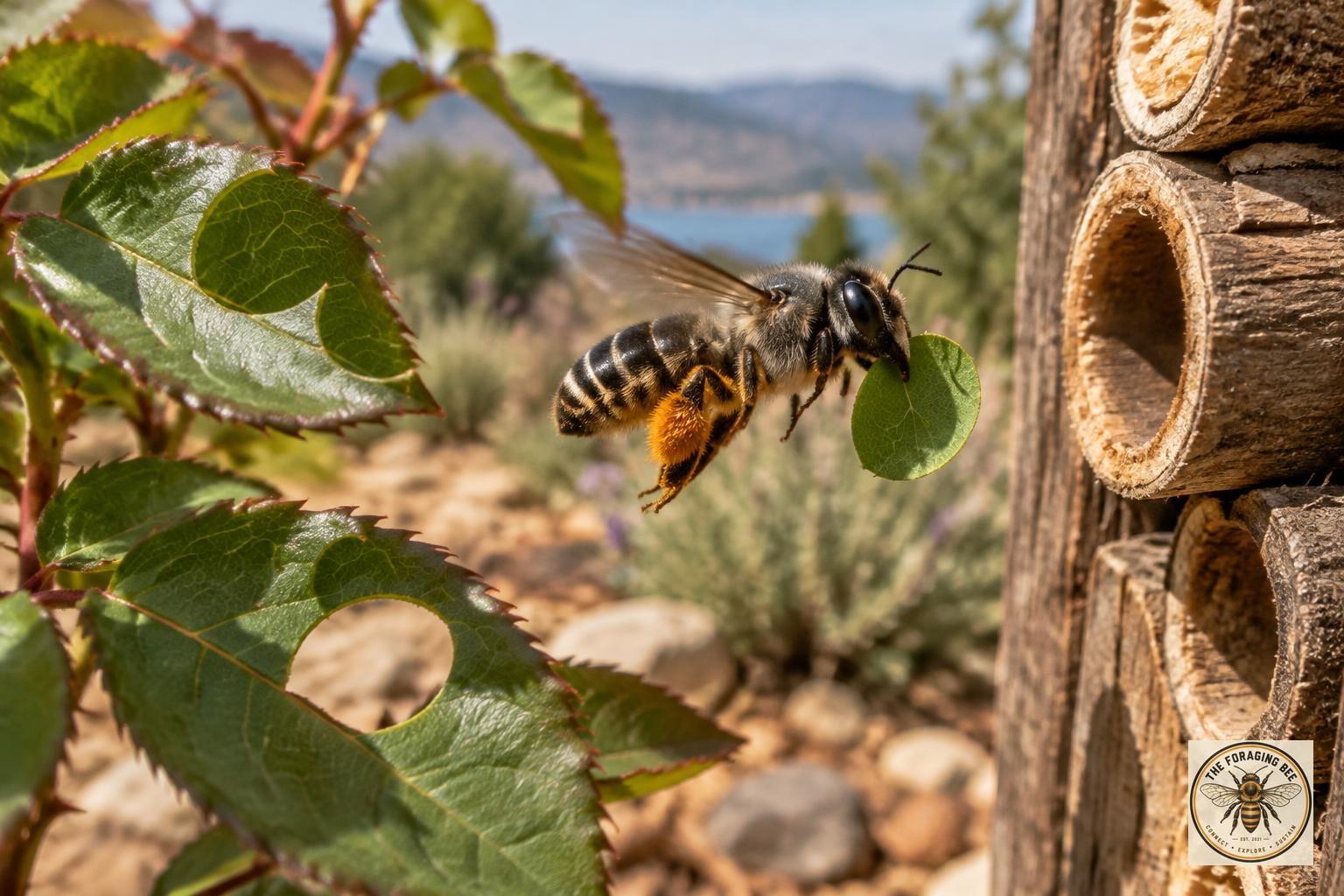
If you have ever found perfect half-moon or round holes cut from the edges of rose, lilac or other soft leaves, you have probably met a leafcutter bee (genus Megachile). British Columbia has a number of native leafcutter species. Like mason bees they are solitary—no queen, no hive and no honey—and they are gentle, stinging only if handled roughly.
Leafcutters are the summer partner to the spring mason bee: when mason bees finish in late spring, leafcutters take over the nesting tubes in the warm months.
HOW TO IDENTIFY IT
• Size: medium, often about the size of a honey bee, but stouter with a broad, flat-topped head. • Body: dark, often with pale bands of hair across the abdomen. • Pollen brush: females carry pollen on a thick brush of hairs under the belly, not on the legs. A belly glowing yellow or orange with pollen is a strong clue. • Behaviour: females fly carrying a rolled piece of leaf, and often raise their abdomen while feeding on a flower. • Signs: neat circular cuts on leaf edges. These do little harm to a healthy plant.
LIFE CYCLE: A SUMMER BEE
Early summer – emergence. Leafcutters spend the winter as mature larvae inside leaf-wrapped cells, and they need warm weather to finish developing. They usually emerge once early summer heat arrives. Males appear first; females mate soon after emerging.
Summer – nesting. A female finds a hollow stem, beetle hole or nesting tube. She cuts pieces of leaf, carries them home and wraps them into a thimble-shaped cell. She fills it with pollen and nectar, lays one egg and caps it with more round leaf pieces. Cell by cell she fills the tube, then plugs the entrance with leaves.
Late summer and winter – growing inside. The larva eats its food, then rests as a larva through autumn and winter, protected by its leafy wrapping. When summer warmth returns, it pupates, becomes an adult and chews its way out.
WHY IT MATTERS TO OUR PLANET
Leafcutter bees are efficient pollinators of summer wildflowers, garden flowers and many crops. Their relatives are so good at pollinating that a non-native leafcutter is managed for alfalfa seed. Our native species quietly keep summer meadows, gardens and roadside flowers setting seed, which feeds birds and the whole food web.
HOW YOU CAN HELP
• Leave some leaf damage on roses and shrubs—those holes are a sign of life. • Offer clean nesting tubes or drilled wood blocks (about 6–8 mm holes) in a sunny, sheltered spot, and replace or clean them so pests don't build up. • Plant summer bloom: asters, sunflowers, clovers, blanketflower and native wildflowers. • Keep flowering plants free of pesticides.
THE 4H VIEW
Harmony is a season-long chain of blooms and bees. When leafcutters follow mason bees in the same garden, you are watching that chain at work.
FIELD NOTE
Count the leaf circles you find in July. More cut leaves usually means more nests nearby.
Sources and boundaries
Native bee habitat and nesting guidance.
Biology, identification and life cycle of the genus.
Provincial apiculture and pollinator resources.