Honey, wax & pollen processing
Processing Your Own Pollen: Clean Handling, Careful Storage
From monitored collection to labelled cold storage: protect the colony’s food, distinguish bee feed from human food and avoid unverified drying or shelf-life claims.
Mark Vanderende · October 29, 2026
POLLEN BELONGS TO THE BEES FIRST
Learn responsible pollen collection from healthy colonies during abundance, safe handling and storage. Leave brood-side bee bread and winter honey; never collect through a shortage or share unverified feed.
Bees store pollen as bee bread beside and above brood. Keep that food close to the young bees; do not strip brood-side pollen stores during harvest or routine frame changes.
A full trap drawer is not permission to take pollen indefinitely. Choose healthy, strong colonies during genuine local abundance, monitor the effect and stop when food, weather or colony strength no longer supports collection. Use a suitable, correctly fitted trap with experienced guidance. A colour or busy entrance cannot prove complete nutrition.
This article adds a handling pathway to the Journal’s existing ethical-collection lesson. It does not make every pollen crop suitable for sale or turn bee-feed storage into a validated human-food process.
DECIDE WHAT THE LOT IS FOR
Record whether the intended use is colony care, a supervised food-processing project or another purpose. Do not use unknown or suspect-colony pollen as bee feed. Do not promise that your own apiary’s pollen is free of pesticide residues, pathogens or allergens simply because you collected it yourself.
For human consumption or sale, consult the relevant food authority and establish a suitable process before collecting a marketable batch. Food-contact hygiene, preservation, packaging, labelling and product testing may require more than a beekeeper’s ordinary feed routine.
COLLECT PROMPTLY AND KEEP IT CLEAN
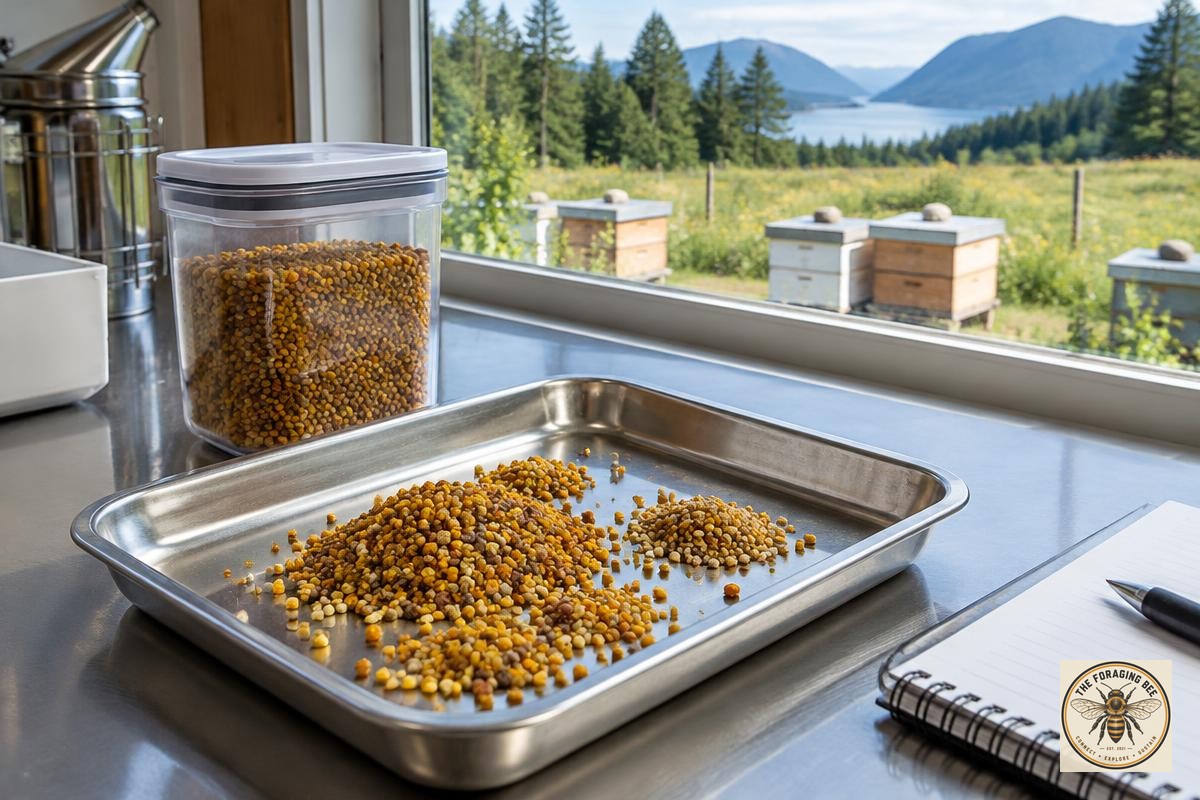
Use clean suitable equipment and collect trap contents frequently so damp material does not sit exposed to insects and weather. Keep soil, hive debris and foreign material out of the batch. Discard spoiled, mouldy or otherwise questionable material rather than mixing it into a better lot.
Work on a clean surface with appropriate utensils and containers. Removing visible debris improves handling but does not sterilise pollen or establish that it is safe to eat. Keep different collection days and source colonies identifiable while you assess them.
PRESERVE WITHOUT GUESSING
Fresh pollen is perishable. Prompt freezing in suitable sealed portions is a preservation option; controlled drying is another process that needs verified conditions and endpoints. Neither should be presented as a universal kill step. Do not publish or rely on a fixed drying time or shelf life without a validated process for the actual product.
Use clean food-grade containers suited to the selected storage method. Label source, collection date, preservation method and intended use. Maintain the chosen storage conditions, record interruptions and avoid repeatedly thawing a large container to take small amounts.
Freezing does not remove pesticide residues or allergens and does not make disease-suspect pollen suitable for feeding. Dry appearance is not proof of a safe moisture level. If preservation has failed or the lot’s history is uncertain, get qualified advice rather than trying to disguise deterioration.
DO NOT OVERPROMISE HUMAN BENEFITS
Bee-collected pollen can cause allergic reactions, including serious reactions in susceptible people. It is not a treatment or a cure, and this article is not advice to begin eating it. People with relevant allergy concerns should consult a qualified clinician. Check required allergen and product information before any sale.
Keeping pollen for your own bees is also not automatically a reason to feed it. First assess need, health and the appropriate local response. The 4H goal is a colony supported by its own forage and stores, with any assistance recorded honestly.
YOUR NEXT STEP
Create a pollen log before setting a trap: colony, forage conditions, collection window, amount taken, handling, storage and the follow-up observation. Make the human-food questions a separate checklist for qualified review. Healthy begins with leaving enough nutrition; Harmony includes knowing the limits of what your harvest can tell you.
Sources and boundaries
Government research guidance discusses hygiene, preservation and packaging; it is not a locally validated food-safety procedure.