Beeginner Beekeeping
1. Plan Your First Season: Bees Before Honey
Begin with curiosity, a local mentor and a realistic plan. Your first season is about building a colony that can enter winter well, not filling jars.
Mark Vanderende · October 29, 2026
BEGIN WITH A QUESTION
Have Fun With your Bees the 4H Natural Way begins before you own a hive. Ask what draws you to bees: learning with your children, understanding nature, building things, or discovering where honey comes from. None of those interests requires an immediate purchase. Visit a working apiary and try a lesson first. Children learn with a guardian; adults of any age can begin with curiosity.
Make your first goal a living colony that reaches winter with sound health, enough bees and its own food. A first-year honey harvest is a possibility, not an entitlement. A small June colony may need everything it gathers to build comb, raise bees and prepare for the cold. Choosing not to harvest can be the best decision of the year.
MAKE A PLAN YOU CAN KEEP
Write down where the hive could stand, who will help, how you will reach it and what happens when you travel. Care takes more than occasional sunny-day visits. You need time for learning, purposeful checks, weather surprises and prompt follow-up when something changes. Find a local beekeeper who can explain what they observe and help you interpret it, rather than simply handing you a calendar.
Budget for bees, compatible woodware, protective clothing, safe tools, health assessment and winter preparation. Ask local suppliers for actual quotes; avoid a bargain that leaves out essential equipment or support. Start at a scale you can care for. More hives are not automatically more learning, and the land must support honeybees alongside other pollinators.
JUNE IS A PLAN, NOT A PROMISE
This series follows a first season built around getting an established local colony in June, or taking a responsibly assessed swarm caught in spring. Those are different starting points. Your site, forage, queen status and colony strength decide what can happen next. A higher Princeton site and a warmer Okanagan valley will not share every milestone.
YOUR NEXT STEP
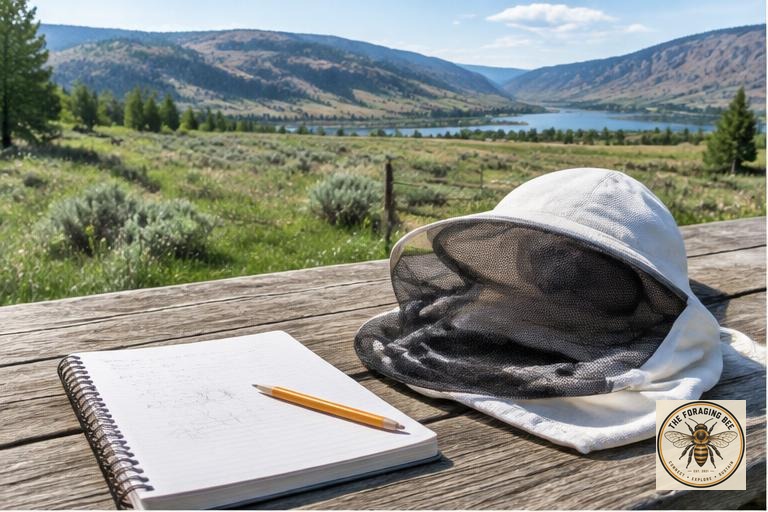
Arrange a learning visit and start a notebook with three lines: my reason for keeping bees, my source of help, and my winter goal. Keep one further question open: what evidence would make me change my plan? Curiosity works best when it can change its mind.
YOUR 4H COMPASS
4H stands for Happy, Healthy, Heavy and Harmony. It is Mark’s way of natural, treatment-free beekeeping: four guiding principles for understanding bees, caring for them and living more attentively alongside nature.
Harmony — work with nature
Read blooms, weather and the wider landscape. Respect other pollinators and let the land’s capacity guide the apiary, rather than forcing it to fit a calendar.
Read these signals
- • Time available for care
- • Local guidance
- • Winter as the first goal
Sources and boundaries
Check current registration, identification, sale and movement requirements, plus the local rules for your property.
Supports known-health sourcing, careful introductions, food and environmental care. Official guidance is broader than Mark’s treatment-free approach; it does not establish guaranteed survival.
Reliable monitoring and records matter. The province also recommends control when indicated; this series does not claim that nonintervention is safe or prescribe a treatment.
Food, nursing bees, queen performance and environment affect growth. Older guidance provides biological context, not a universal June schedule or winter-food target.