Beeginner Beekeeping
3. Prepare Your Woodware and Tools
Get compatible boxes and frames ready before pickup. Learn safe handling, protect natural comb and buy what the bees need—not every gadget.
Mark Vanderende · October 29, 2026
READY BEFORE ARRIVAL
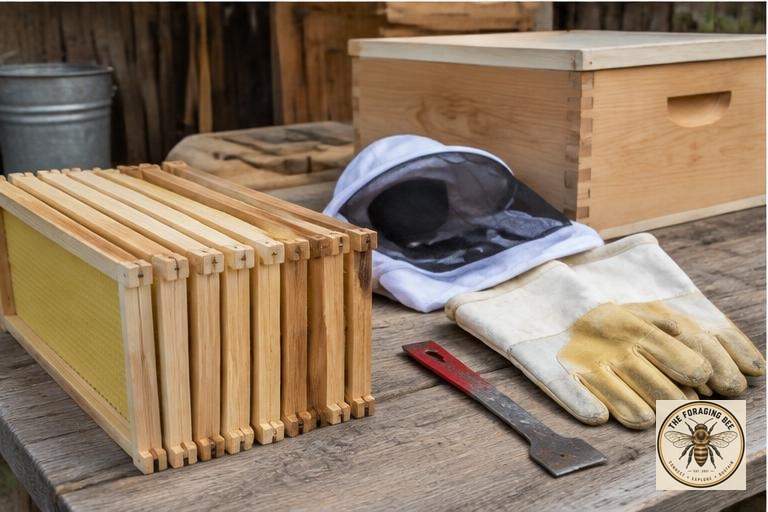
Ask your bee supplier what frame size and hive system the colony uses before buying boxes. A nucleus colony arrives on frames; those frames need to fit the home you have prepared. Confirm the full setup with a mentor: stand, floor, brood box, frames, cover and weatherproof roof. Have the next suitable space available without assuming you should add it immediately.
Choose sound equipment with removable combs and a system you can lift and handle safely. Learn the difference between building a first home and making an advanced queen-rearing cell builder. The 10-over-10 belongs to supervised queen-rearing teaching; it is not an instruction to put every new colony into two empty deep boxes.
BUILD WITH CARE
Making or repairing woodware is part of the closed-loop 4H journey. Learn measurements and joinery from a proven plan. Check square boxes, frame spacing and safe supports before bees depend on them. Use woodworking tools with suitable protection and skilled supervision. Children can help with age-appropriate activities away from hazardous tools.
Keep hive interiors untreated and protect suitably rough surfaces where bees establish their propolis lining. That lining is part of the colony environment, not an excuse to overlook disease. Do not scrape everything clean for appearance. Used comb and equipment need a known health history; low cost does not cancel the risk of introducing disease.
NATURAL COMB NEEDS SKILL
If you learn foundationless frames, set them up correctly with guidance and keep the hive level. Newly built comb is fragile, especially in warmth. Learn to hold it securely without turning an unsupported sheet flat. Do not scatter empty frames through a small brood nest or break up brood warmth simply to copy a technique. Space changes must fit population, weather and the question you are trying to answer.
PROTECTION MAKES LEARNING CALMER
Get a properly fitting veil and appropriate clothing, footwear and gloves. Learn safe hive-tool use and, when needed, minimal safe smoker use within local fire restrictions. Plan what to do about stings and severe reactions; discuss known allergy concerns with a qualified clinician before close bee work. Courage is not measured by taking off your veil.
YOUR NEXT STEP
Assemble the empty home and practise opening, lifting and replacing parts with a mentor. Make a short equipment list and a separate wish list. Spend on safe, useful basics first.
YOUR 4H COMPASS
4H stands for Happy, Healthy, Heavy and Harmony. It is Mark’s way of natural, treatment-free beekeeping: four guiding principles for understanding bees, caring for them and living more attentively alongside nature.
Happy — respect the colony
Learn how bees live and communicate. Observe before intervening, work calmly and disturb the nest only for a clear reason.
Read these signals
- • Compatible frame sizes
- • Stable equipment
- • Safe protection
Sources and boundaries
Check current registration, identification, sale and movement requirements, plus the local rules for your property.
Supports known-health sourcing, careful introductions, food and environmental care. Official guidance is broader than Mark’s treatment-free approach; it does not establish guaranteed survival.
Reliable monitoring and records matter. The province also recommends control when indicated; this series does not claim that nonintervention is safe or prescribe a treatment.
Food, nursing bees, queen performance and environment affect growth. Older guidance provides biological context, not a universal June schedule or winter-food target.