Beeginner Beekeeping
4. Choose Your June Bees: Queens, Nucs and Splits
Ask a local beekeeper for a healthy, established colony with a laying queen and a documented history. Good genetics need evidence, not just a label.
Mark Vanderende · October 29, 2026
BUY A START, NOT A PROMISE
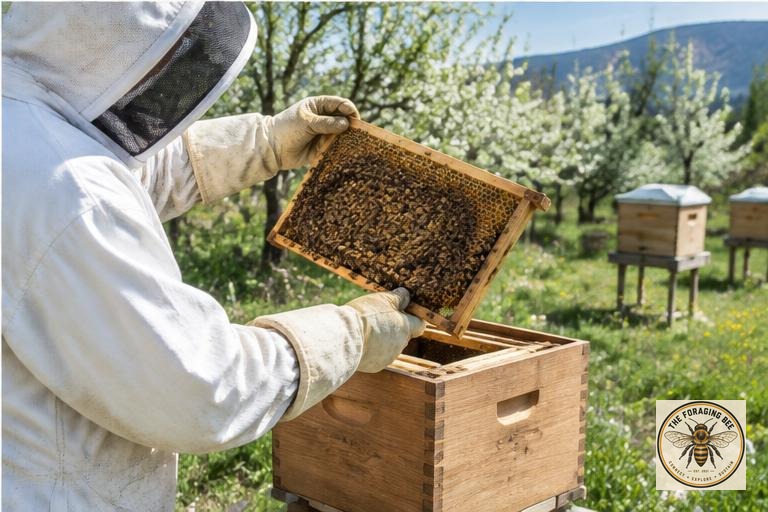
For a planned June start, speak to a local beekeeper well before pickup. Ask for an established queenright nucleus colony or split with a laying queen, brood, adult bees and appropriate food. A nuc is a small working colony. A split describes how a colony was divided; it may have a laying queen, a queen cell or no established queen yet. Those are not equivalent purchases for a beginner.
Have the seller explain exactly what you will receive, the frame size, queen status, expected pickup conditions and support after arrival. A queen-cell split still has mating and laying uncertainty. It should not be described as the same dependable starting point as a colony with verified laying evidence.
WHAT DOES GOOD GENETICS MEAN?
Look for useful records: where the queen was raised, breeder ancestry when known, manageable temperament, colony health, winter survival and spring recovery under comparable conditions. Ask how these traits were assessed over time. A local seller may offer an imported queen; being sold nearby does not itself prove local adaptation.
Local survivor history is valuable evidence, not a guarantee. Open-mated queens can mate with outside drones, and health and winter outcomes also depend on care, food and environment. Be cautious about promises of mite-proof bees or automatic treatment-free success. Ask what was measured rather than accepting a confident name.
CHECK HEALTH BEFORE TRANSFER
Discuss recent Varroa assessment, abnormal brood, inspections and any disease-management history. Ask about required sale or transfer authorization and movement permits for your route. A responsible supplier welcomes practical questions. Do not purchase suspect stock hoping natural comb will solve the problem later.
At handover, learn how the seller reads brood and eggs as evidence of a laying queen without turning queen hunting into a routine. Record the colony source and queen history. Keep a contact for follow-up if development differs from what was expected.
JUNE CHANGES THE GOAL
Your bees still need time and forage to grow, draw comb and store winter food. Ask whether the proposed colony is appropriate for your site and remaining season. A June start can be workable, but there is no universal deadline or promised first-year crop. Winter preparation comes before expansion or honey for the beekeeper.
YOUR NEXT STEP
Write your supplier questions and pickup agreement in the notebook. Confirm equipment compatibility, established queen status, health information, legal requirements and the first follow-up visit before bringing bees home.
YOUR 4H COMPASS
4H stands for Happy, Healthy, Heavy and Harmony. It is Mark’s way of natural, treatment-free beekeeping: four guiding principles for understanding bees, caring for them and living more attentively alongside nature.
Healthy — understand what bees need
Protect food, comb and the hive environment. Learn to recognise sound brood and signs of trouble, and seek help when needed.
Read these signals
- • Laying queen evidence
- • Breeder and health records
- • Food and population at pickup
Sources and boundaries
Check current registration, identification, sale and movement requirements, plus the local rules for your property.
Supports known-health sourcing, careful introductions, food and environmental care. Official guidance is broader than Mark’s treatment-free approach; it does not establish guaranteed survival.
Reliable monitoring and records matter. The province also recommends control when indicated; this series does not claim that nonintervention is safe or prescribe a treatment.
Food, nursing bees, queen performance and environment affect growth. Older guidance provides biological context, not a universal June schedule or winter-food target.