Beeginner Beekeeping
5. A Spring Swarm: Another Way to Begin
A caught swarm can become your first colony, but its queen, health and ancestry may be unknown. Plan skilled collection and careful assessment.
Mark Vanderende · October 29, 2026
A DIFFERENT STARTING POINT
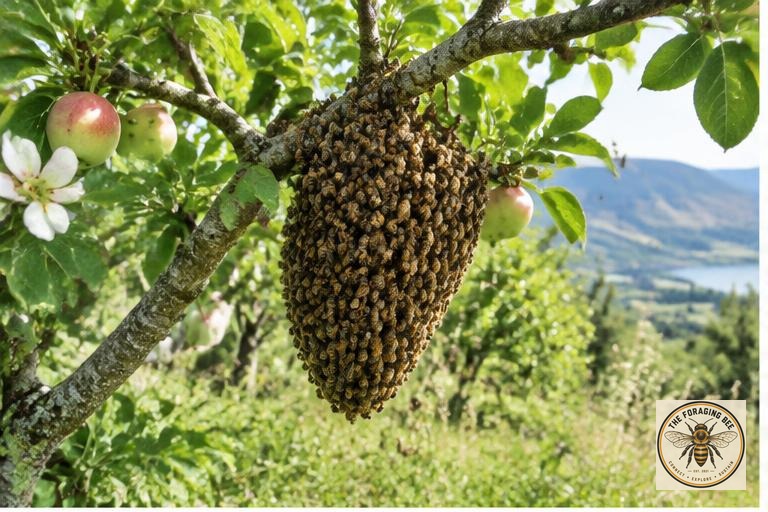
If a spring swarm becomes available, it can be another path into beekeeping. It is not a shortcut around preparation. A swarm is a group of bees that has left a colony with a queen; it must establish a new home. Unlike an established nuc on brood frames, it may arrive without comb, stored food or confirmed laying evidence.
The earlier spring start can offer growing time, but the actual opportunity depends on swarm size, queen status, forage and weather. A late or small swarm has different prospects from a strong early one. Do not promise yourself honey because the bees were free. Their first needs are a safe home, comb, food and a developing colony.
LET SKILLED HANDS DO THE COLLECTION
Call an experienced local swarm collector. Do not climb, use unsafe ladders or attempt a collection beside power lines, roads or other hazards. Confirm permission to access the site. Children can learn from a safe distance with a guardian; they should not be collecting or opening colonies independently.
An exposed swarm on a branch and an established colony inside a building are different jobs. Removing a colony from a wall may involve construction, property damage and specialist work. Do not treat every gathering of bees as a simple box-and-branch collection.
UNKNOWN IS NOT A PEDIGREE
A swarm caught nearby is not automatically local survivor stock. Its ancestry, queen age and previous management may be unknown. Nor is it necessarily diseased. Keep uncertainty honest and assess it rather than guessing. Swarming does not prove Varroa resistance or freedom from pests.
Work with a mentor on biosecurity and suitable separation from other colonies while its condition becomes clearer. Do not swap comb or bees into an established yard simply because the entrance looks busy. Maintain a reliable mite-assessment plan and look for queen performance and healthy development when a purposeful inspection is appropriate.
FOLLOW ESTABLISHMENT
Observe whether the colony settles, builds usable comb and develops laying evidence. A new queen may have a different timetable from an established laying queen; repeated opening cannot hurry mating weather. Equally, unexplained lack of development needs follow-up rather than endless patience. Record the capture date and location, leaving queen ancestry marked unknown until evidence changes it.
YOUR NEXT STEP
Choose either your June-colony plan or an assessed spring-swarm opportunity with your mentor. Then continue to entry six. Both paths lead to the same responsibility: care for the colony you actually have.
YOUR 4H COMPASS
4H stands for Happy, Healthy, Heavy and Harmony. It is Mark’s way of natural, treatment-free beekeeping: four guiding principles for understanding bees, caring for them and living more attentively alongside nature.
Healthy — understand what bees need
Protect food, comb and the hive environment. Learn to recognise sound brood and signs of trouble, and seek help when needed.
Read these signals
- • Safe collection access
- • Unknown queen history
- • New comb and laying evidence
Sources and boundaries
Check current registration, identification, sale and movement requirements, plus the local rules for your property.
Supports known-health sourcing, careful introductions, food and environmental care. Official guidance is broader than Mark’s treatment-free approach; it does not establish guaranteed survival.
Reliable monitoring and records matter. The province also recommends control when indicated; this series does not claim that nonintervention is safe or prescribe a treatment.
Food, nursing bees, queen performance and environment affect growth. Older guidance provides biological context, not a universal June schedule or winter-food target.