
Beeginner Beekeeping
6. Bring Your Bees Home Calmly
Prepare pickup, safe transport and a gentle handover. Keep the brood nest together and arrange the first purposeful check with your mentor.
Mark Vanderende · October 29, 2026
THE HANDOVER IS PART OF CARE
Before pickup, confirm the stand, water, compatible equipment and access are ready. Ask the supplier or collector how the colony will be contained, ventilated, secured and moved safely. Arrange any required authorization in advance. Do not improvise transport in a hot vehicle or leave a closed colony in direct sun.
Follow the supplier’s safe pickup and release instructions for the actual container and conditions. Transport ventilation, containment and temperature matter together. Make the trip practical and avoid unnecessary stops. An exact universal travel routine cannot replace guidance for the bees and equipment in front of you.
KEEP THEIR HOME TOGETHER
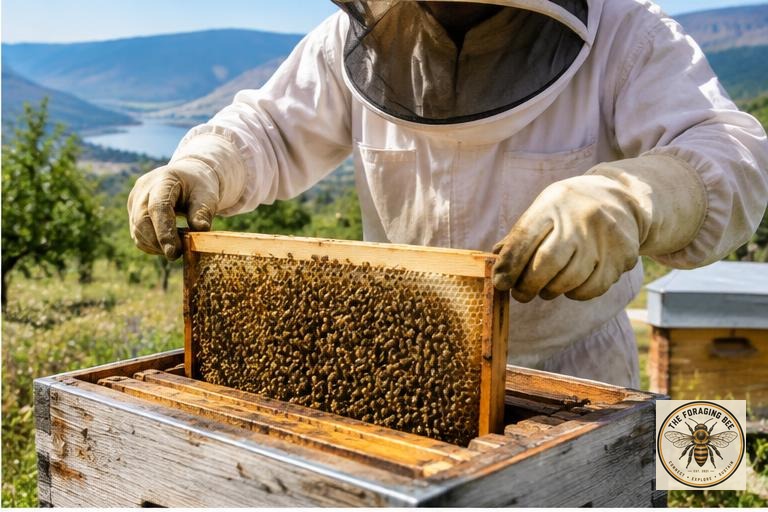
An established nuc already has an arrangement of brood, food and comb. Learn the transfer beside an experienced beekeeper. Preserve the brood nest and frame order unless there is a specific, justified reason to change them. Move deliberately, avoid crushing bees and queen, and keep brood exposure brief under suitable conditions.
A swarm starting on empty frames has a different task. It must build comb and establish itself. Match its space to its population and resources with guidance. Do not place a small group in an unnecessarily large, scattered home because the boxes are available. The colony should be able to occupy and care for the space it receives.
WATCH WITHOUT CROWDING
Once installed, stand out of the flight path and let the bees orient. Avoid inviting everyone to open the hive on its first afternoon. Notice entrance behaviour, water access and weather. These clues provide context, but they do not prove queen status or nutrition. Keep pets and visitors at a sensible distance while you learn the colony’s response.
Agree on the first follow-up with your mentor. Its purpose might be to check establishment, food, comb development or laying evidence. The date should fit queen history, weather and the colony—not a demand to look every day. If there is an urgent problem, do not postpone help simply to preserve a planned quiet period.
START A RECORD THAT LASTS
Give the colony an identifier. Record its source, arrival date, queen information, equipment and what was actually seen at transfer. Mark unknown details honestly. Add the question for the next visit and the person who can help answer it.
YOUR NEXT STEP
Leave with a stable hive, a safe entrance and a written follow-up plan. Enjoy watching your new neighbours without making disturbance the price of your excitement.
YOUR 4H COMPASS
4H stands for Happy, Healthy, Heavy and Harmony. It is Mark’s way of natural, treatment-free beekeeping: four guiding principles for understanding bees, caring for them and living more attentively alongside nature.
Happy — respect the colony
Learn how bees live and communicate. Observe before intervening, work calmly and disturb the nest only for a clear reason.
Read these signals
- • Safe transport and ventilation
- • Stable home
- • First follow-up question
Sources and boundaries
Check current registration, identification, sale and movement requirements, plus the local rules for your property.
Supports known-health sourcing, careful introductions, food and environmental care. Official guidance is broader than Mark’s treatment-free approach; it does not establish guaranteed survival.
Reliable monitoring and records matter. The province also recommends control when indicated; this series does not claim that nonintervention is safe or prescribe a treatment.
Food, nursing bees, queen performance and environment affect growth. Older guidance provides biological context, not a universal June schedule or winter-food target.