Beeginner Beekeeping
7. Learn to LISTEN and Keep Useful Notes
Read the entrance first, ask a clear question and record what changes. Use the five-area audit as evidence—not a reason to open everything.
Mark Vanderende · October 29, 2026
ARRIVE WITH ATTENTION
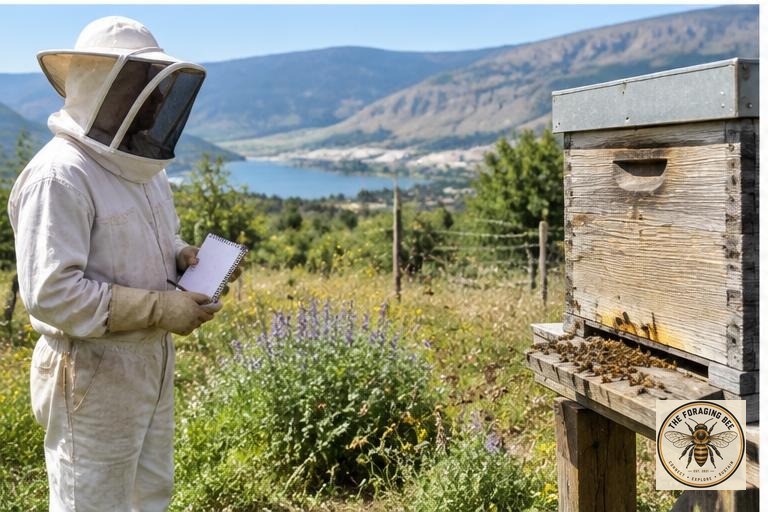
A useful hive visit starts beside the colony, not inside it. Notice the weather, the flight pattern and what is blooming. Watch landings and pollen loads without standing in the entrance path. Compare the scene with earlier visits under similar conditions. A quiet entrance on a cold day is not the same evidence as a quiet entrance during suitable flying weather.
Ask what you need to learn before taking out a tool. Is the colony establishing? Are food reserves keeping up? Has a previous concern changed? An inspection should answer a real question. Outside-first care protects the brood nest without pretending that outside clues can answer every health question.
KEEP OBSERVATION SEPARATE FROM STORY
Write “pollen arriving repeatedly” rather than “nutrition perfect.” Write “brood not assessed today” rather than inventing a reassuring pattern. Sound, cover warmth and hive weight can be useful clues, but none alone proves queen performance or health. Learn to say what you do not know.
When suitable conditions and a clear question warrant opening, work with protection and skilled guidance. Read brood evidence without routine queen hunting. Preserve comb, brood warmth and the propolis lining. Close when the question is answered rather than continuing until every frame has been handled.
USE THE AUDIT AS A SUPPORT
HiveVerity organises five areas: Stores, Brood Pattern, Bee Density, Temperament and Hygiene & Health. Each is scored from 1 to 5 only when there is enough evidence. A complete audit can total 25; a partial observation is not a complete score. Unknown evidence remains unscored.
Any score of 1 or urgent sign overrides the aggregate. A colony with plenty of food can still need immediate help for disease, unsafe aggression or failing brood. A pleasing total is not a health certificate or a guarantee that winter will go well. Health evidence includes appropriate measured mite assessment, not just the absence of visible mites.
MAKE NOTES YOU CAN USE
Keep the colony identifier, date, weather, forage, evidence, action and next check together. Record the result when you return. A decision to leave the lid closed can be useful when you explain why. If a concern persists, the notes help a mentor compare changes without asking you to rely on memory.
YOUR NEXT STEP
Try one short observation visit with a guardian or mentor as appropriate. Write one thing seen, one question unanswered and one justified next action. Good records are curiosity made visible.
YOUR 4H COMPASS
4H stands for Happy, Healthy, Heavy and Harmony. It is Mark’s way of natural, treatment-free beekeeping: four guiding principles for understanding bees, caring for them and living more attentively alongside nature.
Happy — respect the colony
Learn how bees live and communicate. Observe before intervening, work calmly and disturb the nest only for a clear reason.
THE SHARED LISTEN WORKFLOW
L — Look: Watch entrance traffic, landings, pollen and the weather. Pollen colours suggest forage variety, not proof of complete nutrition.
I — Inspect: Read top-bar seams and visible evidence with minimal disturbance. Inspect brood only when a real question warrants it; never hunt for a queen just to prove she is there.
S — Sound: Listen at the entrance or top notch. Compare the colony with previous visits; a hum or roar alone cannot establish queen status or health.
T — Touch: Check cover warmth and heft the hive safely. A cover reading cannot prove the brood nest is at 35°C; wear suitable protection and never touch bees to test temperament.
E — Evaluate: Record Stores, Brood Pattern, Bee Density, Temperament and Hygiene & Health, each 1–5. Unknown evidence stays unscored; a complete audit totals 5–25.
N — Navigate: If unsure, take a photo safely, close up and seek qualified help. Choose the smallest justified action and a follow-up date; disease or starvation needs prompt attention.
Five areas, 1–5 each; total only when all five have sufficient evidence. Unknown is not zero and is never guessed.
Any score of 1 or urgent disease, starvation or unsafe aggression overrides the total.
Read Harmony alongside the audit: local bloom, weather, available forage and responsible closed-loop growth.
A score organizes evidence; it does not certify health, prove queen status or guarantee winter survival.
Read these signals
- • Entrance compared with weather
- • Evidence versus assumptions
- • Action and follow-up
Sources and boundaries
Check current registration, identification, sale and movement requirements, plus the local rules for your property.
Supports known-health sourcing, careful introductions, food and environmental care. Official guidance is broader than Mark’s treatment-free approach; it does not establish guaranteed survival.
Reliable monitoring and records matter. The province also recommends control when indicated; this series does not claim that nonintervention is safe or prescribe a treatment.
Food, nursing bees, queen performance and environment affect growth. Older guidance provides biological context, not a universal June schedule or winter-food target.