Beeginner Beekeeping
8. Grow Comb and Colony—Not Too Fast
Match space to bees, brood and forage. Give a new colony room when the evidence supports it, without rushing a harvest or another split.
Mark Vanderende · October 29, 2026
THE COLONY HAS SEVERAL JOBS
Your new bees need to raise young workers, build or occupy comb, collect food and maintain their home. The queen’s laying contributes to growth, but brood also needs nurse bees, food and suitable conditions. A busy queen cannot turn an undersupplied small colony into a strong one by herself.
Follow the development over several purposeful visits. Notice occupied space, comb progress, brood evidence and the food trend together. Pollen at the door is useful context, not a complete account of what is stored inside. Fresh comb can show building opportunity, but it does not establish good health or a future harvest.
SPACE IS A DECISION
Keep compatible equipment ready so you can add suitable space when needed. Ask a mentor to show how population, occupied comb, congestion, forage and weather influence that decision. There is no single box-adding date that fits every June nuc and spring swarm.
Too little usable room can contribute to congestion; too much poorly arranged space can make it harder for a small colony to care for its home. Preserve brood continuity and warmth. Do not use a photograph of a large production hive as the target for your first small colony. Growth should fit the bees you have today.
CARE FOR NATURAL COMB
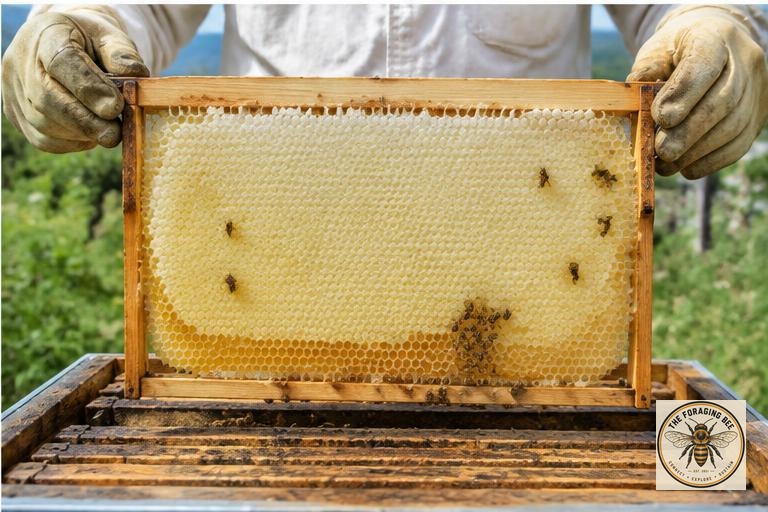
Learn safe frame handling and appropriate support for new comb. Warm, soft comb is not a rigid board. Work carefully over the hive and avoid turning fragile unsupported comb flat. Foundationless work belongs with good setup and a mentor’s explanation, not arbitrary empty-frame insertion into a weak brood nest.
Protect brood-side pollen and the propolis lining as the home develops. Natural comb and propolis support the environment; they do not replace disease checks or measured Varroa assessment. An unexpected loss of brood, population or stores needs diagnosis, not another empty box.
LET EXPANSION WAIT WHEN NEEDED
Closed-loop beekeeping includes raising queens and growing healthy nucs, but you do not have to perform every skill in the first year. Splitting a new colony again can remove the bees and food it needs for winter. Study queen rearing now; practise advanced cell builders and donor decisions later under supervision when colony strength and the season support them.
YOUR NEXT STEP
Review the colony’s growth beside the forage trend. Record why you added space—or why you waited. Keep winter strength ahead of your wish for more colonies or an early honey crop.
YOUR 4H COMPASS
4H stands for Happy, Healthy, Heavy and Harmony. It is Mark’s way of natural, treatment-free beekeeping: four guiding principles for understanding bees, caring for them and living more attentively alongside nature.
Healthy — understand what bees need
Protect food, comb and the hive environment. Learn to recognise sound brood and signs of trouble, and seek help when needed.
Read these signals
- • Bees occupying current space
- • Comb development
- • Growth matched to forage
Sources and boundaries
Check current registration, identification, sale and movement requirements, plus the local rules for your property.
Supports known-health sourcing, careful introductions, food and environmental care. Official guidance is broader than Mark’s treatment-free approach; it does not establish guaranteed survival.
Reliable monitoring and records matter. The province also recommends control when indicated; this series does not claim that nonintervention is safe or prescribe a treatment.
Food, nursing bees, queen performance and environment affect growth. Older guidance provides biological context, not a universal June schedule or winter-food target.