Beeginner Beekeeping
9. Plan for Summer Food Gaps and Health
Summer sunshine can hide a shortage. Track honey, pollen and mite evidence before dearth and winter-bee development make a small problem larger.
Mark Vanderende · October 29, 2026
FLOWERS CHANGE BEFORE THE CALENDAR DOES
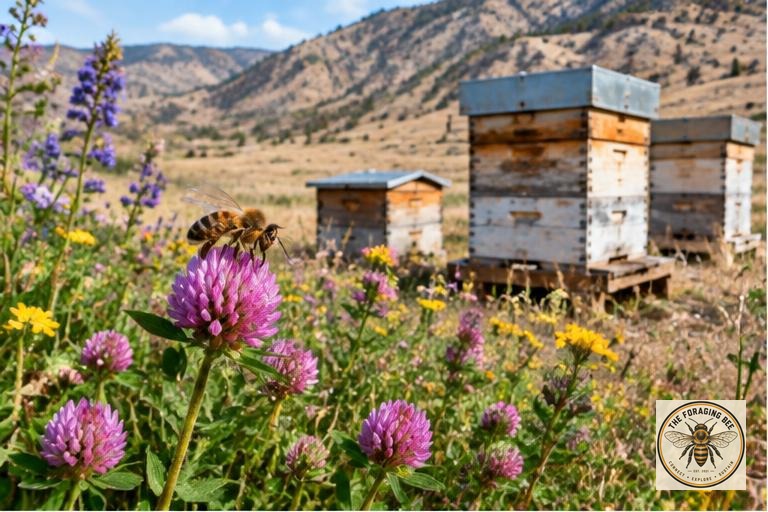
Hot, dry southern-interior weather can reduce forage even when the sky looks ideal for flying. Walk the landscape again. What has finished flowering? What remains within reach? Is rain or wind limiting collection? Compare these observations with the hive’s reserves rather than assuming summer means abundance.
Honey fuels activity and warmth; pollen helps support the growing bees. A colony can have one resource and be short of the other. Keep brood-side bee bread where the bees need it. Watch for declining usable stores, interrupted development or unusual entrance conflict. A busy doorway alone cannot rule out a shortage.
KEEP FOOD FOR THE COLONY
For a first-year hive, pollen collection is usually a skill to study rather than a harvest to demand. Responsible collection belongs to healthy colonies during genuine abundance, with safe handling and storage and enough left for the bees. Do not trap pollen during a gap or strip the food around brood.
The 4H goal is to build and retain the colony’s own honey. If it is falling short, cancel the harvest and seek prompt local guidance on responsible care. An ideal must not turn into permission to let bees starve. Do not use unverified honey or pollen from other colonies as feed or expose communal feed that encourages robbing.
MEASURE HEALTH BEFORE WINTER
Reliable Varroa assessment matters even when you cannot see mites on adult bees. Learn a suitable monitoring method from a qualified local adviser and follow a season-appropriate schedule for each colony. Keep actual results and method details, not just “looked healthy.” One low result is not proof of resistance, and populations can change through the season or after drifting and robbing.
The Foraging Bee teaches a natural, treatment-free approach. That is not monitoring-free or consequence-free. Rising mite evidence, abnormal brood or declining bees require timely advice and an effective response plan. This series does not provide a treatment recipe or promise that natural comb, propolis, a swarm brood break or good ancestry will solve a serious health problem.
DO NOT SPREAD A PROBLEM
If disease is suspected, do not move bees, brood, food or comb to another colony or combine colonies. Ask the provincial bee program or qualified inspector for guidance and follow reporting requirements. Local help is most useful before a colony is collapsing.
YOUR NEXT STEP
Update the bloom, food and health notes together. Agree on the next assessment and the specific evidence that would trigger action. Healthy winter bees begin with summer decisions.
YOUR 4H COMPASS
4H stands for Happy, Healthy, Heavy and Harmony. It is Mark’s way of natural, treatment-free beekeeping: four guiding principles for understanding bees, caring for them and living more attentively alongside nature.
Healthy — understand what bees need
Protect food, comb and the hive environment. Learn to recognise sound brood and signs of trouble, and seek help when needed.
HONEY AND POLLEN IN THE 4H WAY
Honey is energy: Honey supplies carbohydrates for flight, daily work and winter warmth. Leave abundant, reachable honey before taking a surplus.
Pollen is nutrition: Pollen supplies protein, fats and other nutrients. Nurse bees use it to develop the glands that produce brood food; good nutrition also supports the fat body, a tissue involved in nutrient storage and immune function.
Protect the pollen arch: Bees store pollen as bee bread beside and above brood. Keep that food close to the young bees; do not strip brood-side pollen stores during harvest or routine frame changes.
Read the forage gap: Watch local blooms, returning pollen and weather that prevents flight. Colours are clues, not a protein test. Entrance traffic alone cannot prove adequate stores or nutrition; investigate a suspected shortage promptly with qualified help.
Pollen needs vary with the season and colony. There is no single protein percentage or fixed pollen-arch size that proves good nutrition. Do not use unverified honey or pollen from other colonies as feed: it can spread disease.
Read these signals
- • Changing bloom and drought
- • Food trends
- • Measured mite evidence
Sources and boundaries
Check current registration, identification, sale and movement requirements, plus the local rules for your property.
Supports known-health sourcing, careful introductions, food and environmental care. Official guidance is broader than Mark’s treatment-free approach; it does not establish guaranteed survival.
Reliable monitoring and records matter. The province also recommends control when indicated; this series does not claim that nonintervention is safe or prescribe a treatment.
Food, nursing bees, queen performance and environment affect growth. Older guidance provides biological context, not a universal June schedule or winter-food target.