Learning Objectives
- Work a diagnostic sequence on a suspect brood frame instead of guessing from a photograph.
- Perform and interpret the AFB rope test, and know what a positive one obliges you to do.
- Distinguish EFB from AFB, chalkbrood from sacbrood, and all of them from a failing queen or chilled brood.
- Understand nosema (Vairimorpha) as a gut disease with no visible brood sign, and when a sample is worth sending.
- Recognise parasitic mite syndrome — the varroa-and-virus picture that mimics foulbrood.
- Meet British Columbia's registration, reporting and notifiable-disease obligations under the Bee Act.
- Sterilise, irradiate or burn equipment correctly, and stop a disease at one hive instead of a yard.
Field infographic
Reading a bad brood frame
Four signatures, four different mornings.
Ropes >2 cm
American foulbrood
Sunken, greasy, punctured caps; glue-pot smell; hard scale on the lower cell wall. Reportable in BC.
Twisted larvae
European foulbrood
Dies before capping, yellow-white, sour smell, no rope. Often stress-driven during a dearth.
White mummies
Chalkbrood
Chalky larvae at the entrance. Damp, chilled or weak colonies — fix ventilation and requeen.
Spotty + DWV
Parasitic mite syndrome
Scattered brood with crawling, deformed-wing adults. It is a mite problem wearing a brood costume.
Suspected AFB: close the hive, do not shake bees between boxes, and contact the BC Provincial Apiculturist.
Diagram
Development times by caste
Egg to emerging adult — queen 16 days, worker 21, drone 24. Click a band to read that stage.
Queen
16 days
Fed royal jelly the whole way. Emerges day 16, mates about day 21, lays by day 24.
Worker
21 days
Egg 3 · larva 6 · capped 12. Capped worker brood is flat and biscuit-coloured.
Drone
24 days
Bullet-shaped domed cappings. No sting, no foraging — mating only.
Learn these three numbers first — almost every field decision is timed off them.
Read these first
This chapter assumes the ground covered below. If any of it is unfamiliar, take the detour — the sequence exists so nothing here has to be taken on faith.
Reading mode
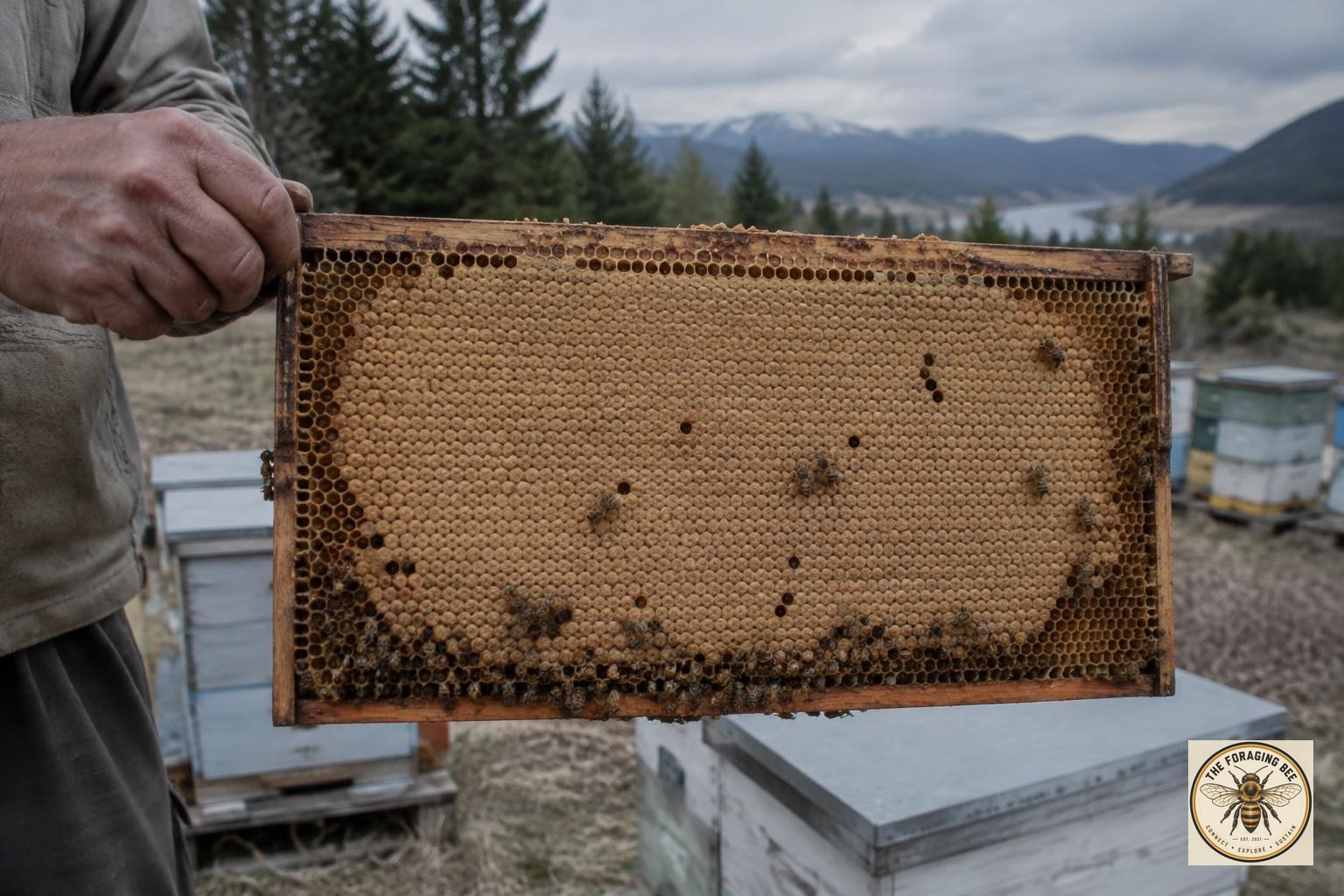
Every beekeeper eventually stands over a frame that looks wrong and feels the specific loneliness of not knowing what they are looking at. Sunken cappings, a smell that is not quite honey, a pattern that has gone from wall-to-wall to shotgun in three weeks. This chapter exists so that moment becomes a procedure instead of a panic. The brood frame is the colony's medical chart. Adult bees hide their problems well and die away from home; the brood cannot, and it records everything that has happened in the last three weeks.
Work in order. Look before you touch, touch before you conclude, and conclude before you treat. Most beekeepers reverse that sequence and treat a diagnosis they never made, which is how a yard ends up medicated against something it does not have while the actual problem — nine times out of ten in this valley, varroa and the viruses it carries — keeps going.
The diagnostic sequence on a suspect frame
- 1Position the frame with the sun over your shoulder so light falls to the bottom of the cells. You cannot diagnose brood in shadow.
- 2Read the pattern first, from a metre back. Solid and even, or shotgun? Is the empty space scattered through capped brood, or is it a clean ring the queen simply has not reached?
- 3Read the cappings. Healthy cappings are dry, slightly convex, uniformly tan. Note anything sunken, darkened, greasy-looking, perforated or chewed at the edge.
- 4Read the larvae. Healthy open brood is pearly white, C-shaped, glistening, segmented, lying in a pool of royal jelly. Note anything yellow, brown, melted, twisted in the cell, or dried to a scale.
- 5Smell — deliberately, once, close. Healthy brood smells of warm wax and honey. Foul, sour, or 'old glue' smells are diagnostic information, though never on their own.
- 6Do the rope test on any sunken, perforated capping. Ten seconds with a matchstick answers the most serious question you will ever ask of a hive.
- 7Only then check the adults: crawling bees, K-wings, deformed wings, shiny hairless bees, dysentery streaking on the front of the box.
- 8Write it down before you close up. Frame number, side, what you saw. Photographs help the inspector; a written note helps you.
Watch — Guelph HBRC
Varroa Mites, Nosema Disease and Viruses — Dr. Ernesto Guzman
What to watch for — This is the single best free lecture on the varroa–virus–nosema complex from a Canadian research perspective. Watch specifically for how the symptoms of virus load overlap with what beekeepers call 'a disease problem'. Most of what gets reported to me as foulbrood is this picture instead.

Student chapter
The rest of this chapter is behind the hive gate.
You are reading the open preview of "Reading the Brood: Disease Diagnostics and BC Reporting". The full chapter — about 14 minutes of it, the beginner and advanced sidebars, the printable field cards and the paired Guelph video work all sit behind a Hive Key.
What a Hive Key opens
- Every chapter in full, both reading tracks
- Printable field cards — mite thresholds, feed schedule, queenright
- The Guelph HBRC video library, paired chapter by chapter
- The Princeton season dashboard, twice a month
How to get one
Ask Mark about access to the full lessons. Hands-on workshops are a separate offer: $25 per session for youth and students, $35 for adults. No Hive Key is needed to sign up for a workshop.
Workshop prices & signup →Track your way through the curriculum
Students with a Hive Key get completion ticks, percent-through-track and a resume button across every chapter.
Open the student desk →From Section V — Troubleshooting, Remedies & Field Hacks