
Learning Objectives
- Distinguish swarm cells from supersedure and emergency cells at a glance.
- Relieve brood-nest crowding with reversals, checkerboarding and timely supering.
- Execute an artificial swarm split that keeps the honey crop and the colony's genetics.
- Read the Similkameen bloom calendar as the trigger for each spring intervention.
- Build a fixed inspection cadence through swarm season instead of reacting to symptoms.
- Recover a colony that has already started swarm preparations before you caught it.
Field infographic
The swarm clock
From first queen cup to an empty box — you get about nine days.
- Day 0
Play cups
Empty cups are normal. Cups with eggs or royal jelly are a countdown.
- Day 3
Charged cell
Larva floating in jelly. Act now: space, split or checkerboard.
- Day 8
Capped cell
Prime swarm usually leaves within 24–48 hours of the first cap.
- Day 9
Swarm issues
Half the workforce and the laying queen leave on the first warm, still afternoon.
- Day 16
Virgin emerges
Afterswarms follow if cells are not reduced to one.
- Day 24+
Laying again
Three weeks of lost brood — the flow is usually gone by then.
Inspect on a 7-day cycle from dandelion to the end of June. Ten days is not a cycle, it is a gamble.
Read these first
This chapter assumes the ground covered below. If any of it is unfamiliar, take the detour — the sequence exists so nothing here has to be taken on faith.
Reading mode
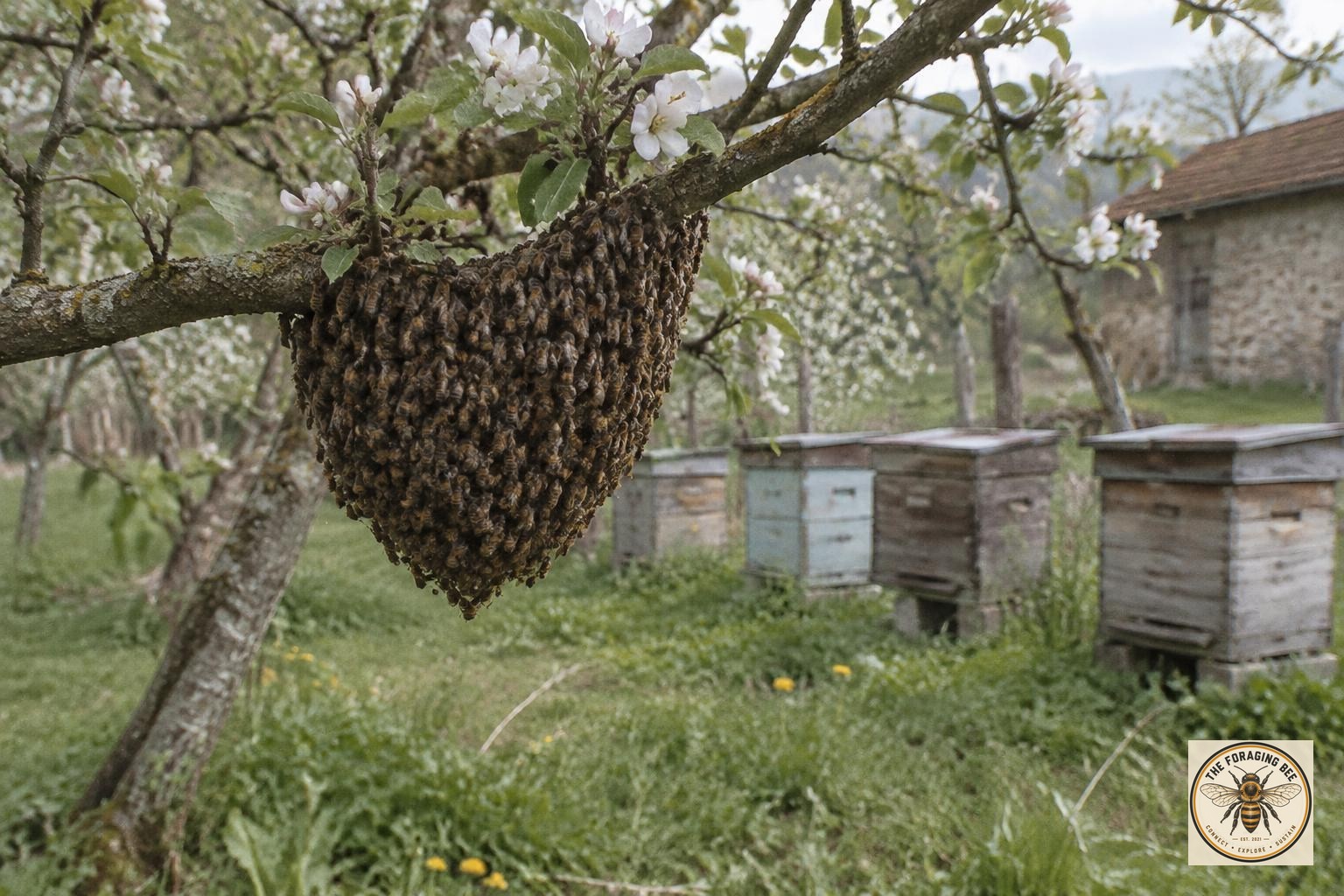
Swarming is success, not failure. It is the colony reproducing at the level of the superorganism, and a colony that never feels the urge to swarm is not a thriving colony — it is usually a queenless, failing, or simply undersized one. Our job as beekeepers is not to eliminate the impulse. It is to redirect it into equipment we control, on a schedule we set, instead of watching half our bees disappear into a cottonwood forty feet up on a Tuesday afternoon while we are at the far end of the yard.
The single hardest lesson in this chapter is one of timing: by the time you see charged swarm cells with larvae floating in royal jelly, the colony's decision was made roughly ten days earlier, when the brood nest first became congested and the nurse bees began backfilling comb with nectar instead of leaving it open for the queen to lay. Everything in swarm prevention is about acting on that ten-day-earlier signal, not on the cells themselves.
Reading cells correctly
Beginners lump every queen cell into one category and either panic or ignore all of them. Learn to read what kind of cell you are looking at before you decide what to do about it.
- Swarm cells — numerous, typically along the bottom bars and outer frame edges, built during active buildup with a healthy, laying queen still present in the hive. This is a crowding signal, and it means the colony intends to leave with the old queen once the first cell is capped.
- Supersedure cells — few in number, usually just one to three, built on the face of the comb rather than the edges, typically with a failing or ageing queen still laying nearby. The colony is quietly replacing her, not preparing to swarm.
- Emergency cells — modified worker cells on the comb face, built hurriedly after sudden, unplanned queen loss. These are often irregular in shape and location, and the timing tells you the story: no queen cells one week, cells everywhere the next, with no laying queen anywhere in the hive.
| Cell type | Location | Queen status | Correct response |
|---|---|---|---|
| Swarm cells | Bottom bars, frame edges, often many | Healthy queen still laying | Relieve crowding immediately or execute artificial swarm split |
| Supersedure cells | Comb face, usually 1–3 cells | Failing queen still present | Allow to proceed; do not disturb the process |
| Emergency cells | Comb face, irregular, converted worker cells | No queen found, brood present but no eggs | Confirm queenlessness before acting; consider combining or requeening |
| Charged swarm cells (capped) | Bottom bars, capped and curved | Queen may have already left with prime swarm | Split immediately; assume the swarm may already be gone |

Student chapter
The rest of this chapter is behind the hive gate.
You are reading the open preview of "Spring Buildup, Box Flipping and Stopping Swarms Early". The full chapter — about 11 minutes of it, the beginner and advanced sidebars, the printable field cards and the paired Guelph video work all sit behind a Hive Key.
What a Hive Key opens
- Every chapter in full, both reading tracks
- Printable field cards — mite thresholds, feed schedule, queenright
- The Guelph HBRC video library, paired chapter by chapter
- The Princeton season dashboard, twice a month
How to get one
Ask Mark about access to the full lessons. Hands-on workshops are a separate offer: $25 per session for youth and students, $35 for adults. No Hive Key is needed to sign up for a workshop.
Workshop prices & signup →Track your way through the curriculum
Students with a Hive Key get completion ticks, percent-through-track and a resume button across every chapter.
Open the student desk →From Section III — Field Skills, Inspections & Early Season