The Foraging Bee master sealThe Foraging BeeConnect · Explore · Sustain
← EduBeeThe Foraging Bee honeybee master seal

Section VI–VII · Chapter 27

Brother Adam's Method: Closed-Population Breeding and the Buckfast Idea

Buckfast Abbey's seventy-year breeding programme, translated into a Similkameen yard. Trait scoring, closed populations, isolated mating, combination crosses and the discipline of culling the queen you like.

12 min read · Mark Vanderende, Master Beekeeper

Follow the apiary
Share this chapter
Marked honeybee queen with a paint dot on her thorax surrounded by her retinue
Brother Adam bred for the whole animal — temper, thrift, vigour and health together.

Learning Objectives

  • Explain what Buckfast actually is — a breeding method and a composite population, not a trademarked race of bee.
  • Score a colony against Brother Adam's trait list rather than a general impression of 'a good hive'.
  • Run a closed-population breeding programme on a small yard without collapsing genetic diversity.
  • Design a combination cross: introduce a trait, then breed the rest of the donor's baggage back out.
  • Use isolated or semi-isolated mating, drone flooding and instrumental insemination realistically at Princeton scale.
  • Recognise when your own overwintered survivor stock is already the best breeding material you own.

Field infographic

Selection scorecard

Rank every breeder colony on the same six traits, every season, in writing.

  • Temperament

    20%

    Sits on the comb, no running, no follow-back at the truck.

  • Hygienic / VSH

    25%

    Freeze-killed brood test: 95%+ cleared in 24 hours to stay in the programme.

  • Wintering & thrift

    20%

    Comes through on modest stores and builds without heavy feeding.

  • Spring build-up

    15%

    Matched to the valley's dandelion date — not too early, not late.

  • Honey yield

    10%

    Ranked within the yard, never against another yard's season.

  • Swarm restraint

    10%

    Low swarm impulse under the same management as its neighbours.

Closed population: saturate the mating area with drones from your best two or three lines, then breed forward.

Diagram

Worker anatomy — functional detail

Structures you cite when diagnosing behaviour, nutrition and pheromone state.
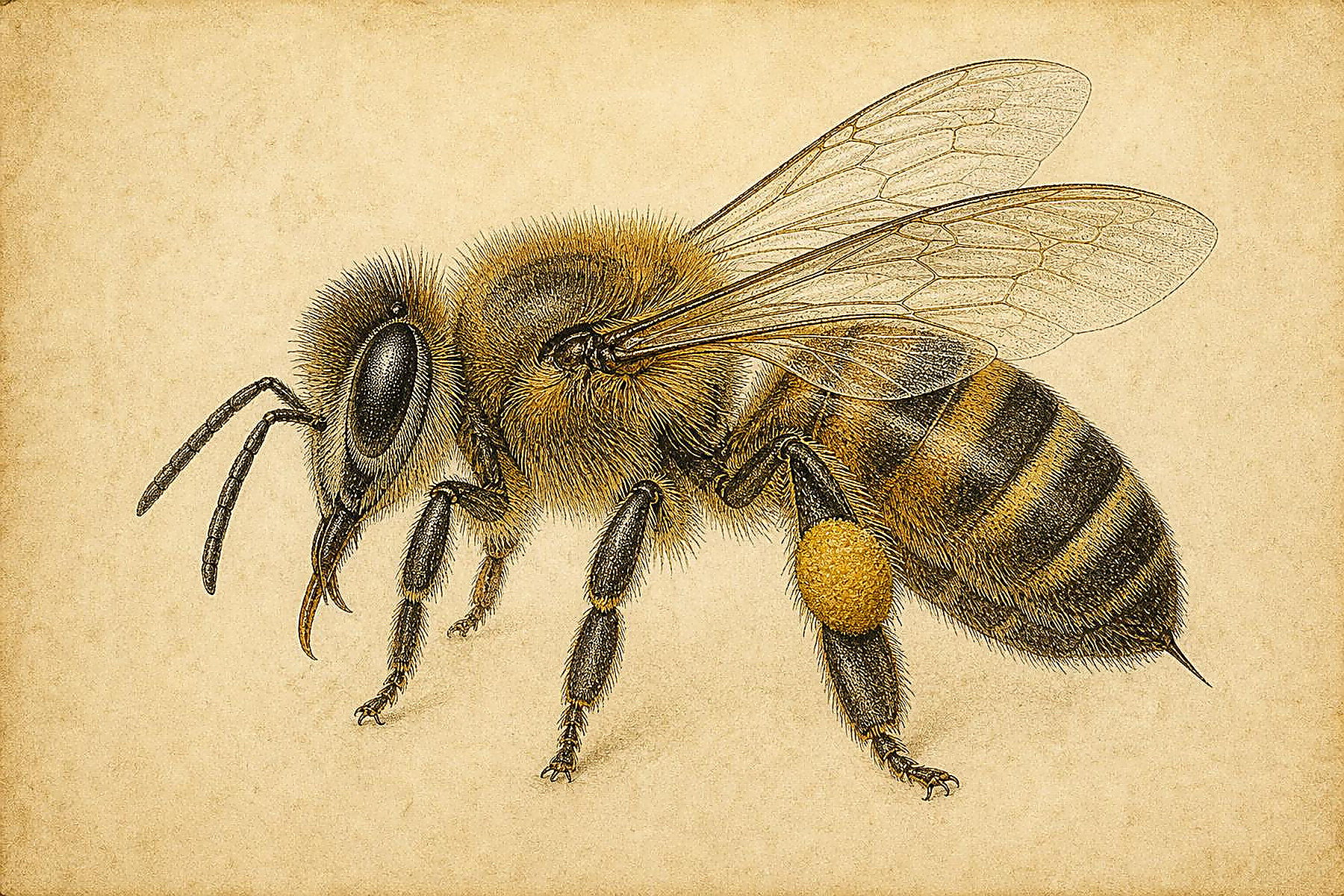
Natural-history illustration of a worker honeybee with 10 numbered anatomical markers

Marker 1

Antenna

≈170 plate organs per flagellum; CO₂, humidity and pheromone sensing.

Fat-body condition and vitellogenin titre — not calendar date — determine whether an adult is a summer bee or a winter bee.

Read these first

This chapter assumes the ground covered below. If any of it is unfamiliar, take the detour — the sequence exists so nothing here has to be taken on faith.

Reading mode

In 1919 an epidemic of acarine disease — tracheal mite — had emptied most of the hives at Buckfast Abbey in Devon. Of forty-five colonies, sixteen survived, and every one of the survivors carried Italian blood. A young monk named Karl Kehrle, known in the world as Brother Adam, drew the correct conclusion from that dead-out: resistance is heritable, and therefore it is selectable. He spent the next seventy years proving it. The bee that came out the other end of that work is not a race in the way Carniolan or Italian is a race. It is a composite, deliberately assembled from stock he collected on breeding expeditions across Europe, North Africa and the Middle East, then folded together under a single ruthless standard.

I put this chapter in the curriculum for one reason. Most beekeepers, including most good ones, never breed. They buy queens, they replace failures, and they treat genetics as something that arrives in a cage from somewhere warmer. Brother Adam's method is the argument that the beekeeper standing in the yard is the selection pressure — that what you tolerate, you propagate. Combined with Michael Palmer's economics of the closed-loop nucleus yard, it is the whole of what I teach in Section VI and VII: raise your own, judge them honestly, and let the Similkameen winter do the rest of the culling.

The greatest obstacle to progress in bee breeding is the beekeeper's own attachment to a favourite colony.

Paraphrasing Brother Adam, Beekeeping at Buckfast Abbey

Watch — Guelph HBRC

Buckfast Breeding Presentation

What to watch for — Listen for how the breeding programme is described as a population, never as a single prized queen. Every time they say 'line' or 'family', translate it in your head to 'a group of sister queens I can compare fairly against each other in the same yard, in the same weather'. That comparison, not the individual queen, is the whole apparatus.

University of Guelph HBRCOpen resource →

What Buckfast actually means

There is a great deal of confusion sold under the Buckfast name, so let us fix the definition before we build on it. Buckfast is not a subspecies. Apis mellifera mellifera, ligustica, carnica and caucasica are subspecies — geographically isolated populations with distinct morphology and behaviour. Buckfast is a synthetic population: a managed mixture of those bloodlines held stable by continuous selection against a written standard. The moment selection stops, the population drifts and the name means nothing. A 'Buckfast' queen from an unselected open-mated yard is a marketing word attached to a mongrel, which may or may not be a good bee.

This is liberating rather than discouraging. It means the method transfers. You are not trying to acquire Buckfast bees; you are trying to run a Buckfast programme on whatever stock survives your climate. My breeding base in Princeton is overwintered survivor stock with Carniolan tendencies — bees that shut brood down hard in a dry August and cluster tight through a minus-twenty week. That is my raw material. Brother Adam's contribution is the discipline applied to it.

The Foraging Bee explorer seal

Student chapter

The rest of this chapter is behind the hive gate.

You are reading the open preview of "Brother Adam's Method: Closed-Population Breeding and the Buckfast Idea". The full chapter — about 12 minutes of it, the beginner and advanced sidebars, the printable field cards and the paired Guelph video work all sit behind a Hive Key.

What a Hive Key opens

  • Every chapter in full, both reading tracks
  • Printable field cards — mite thresholds, feed schedule, queenright
  • The Guelph HBRC video library, paired chapter by chapter
  • The Princeton season dashboard, twice a month

How to get one

Hive Keys are issued to Hive Awakening students. Book a seat at the Princeton apiaries and your key comes with the confirmation — Tier 1 for the Beginner Masterclass, Tier 2 for the Master's Apiary.

See the 2027 workshops →

Track your way through the curriculum

Students with a Hive Key get completion ticks, percent-through-track and a resume button across every chapter.

Open the student desk →

From Section VI–VIIClosed-Loop Queen Rearing & Genetics

Follow the apiary
Share this chapter

Watch alongside this chapter

From the Guelph Honey Bee Research Centre

Watch — Guelph HBRC

Buckfast Breeding Presentation

What to watch for — The clearest short treatment of Brother Adam's method I can point you at: closed-population mating, composite stock, and evaluation held over multiple generations before a line is trusted.

University of Guelph HBRC (presentation)Open resource →
Full video library →

Continue the manual

Join Us

Get the next chapter.

EduBee entries, 2027 Hive Awakening seats and seasonal honey pulls.